What It Is and Key Specs
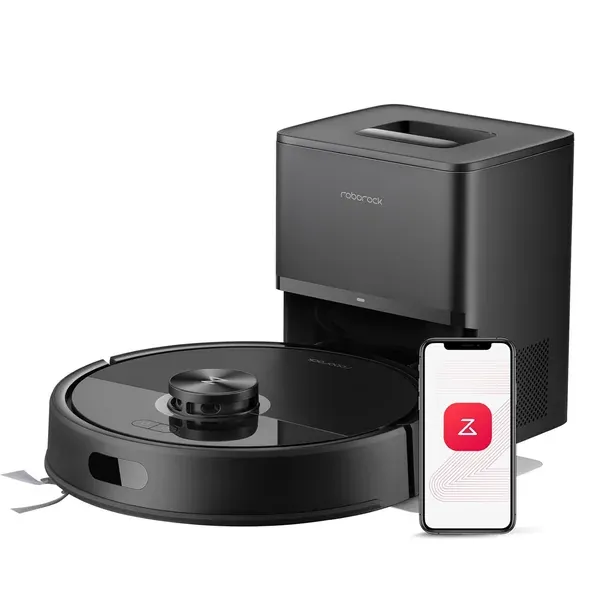
The Roborock Q7 M5+ is a robot vacuum and mop packaged with the RockDock Plus auto-empty base station. According to the manufacturer, the dock uses a 2.7L sealed dust bag that can go 7–9 weeks between emptying, positioning this model as a genuinely hands-off cleaning solution between maintenance cycles. The robot itself delivers 10,000Pa of HyperForce suction, which Roborock positions as high-performance performance across both hard floors and carpets.
Navigation is handled by PreciSense LiDAR — a 360° laser-mapping system that builds a real-time floor plan of the home and optimizes cleaning paths accordingly. The Roborock app (2.4GHz Wi-Fi only) lets users schedule cleanings, set no-go zones, run spot cleans, and monitor battery and progress remotely. Mopping is supported via three adjustable water flow settings, allowing users to dial in moisture levels based on floor type and soil level. The Q7 M5+ is positioned by Roborock as an upgrade from the Q5 Max+.
Build Quality and Safety
The Dual Anti-Tangle system is a headline feature here, combining what Roborock calls a JawScrapers main brush and a "0% hair-tangling" side brush. The intent is to minimize the hair-wrap interruptions common with robot vacuums in pet households, including those with long-haired breeds.
Independent testing at Vacuum Wars recorded a max suction measurement of 2.24 kPa for the Q7 M5+, substantially higher than comparative models tested in the same review — context that supports the manufacturer's high-suction claims in relative terms.
On safety: no CPSC recalls are on record for Roborock products of this type as of July 24, 2026, per
saferproducts.gov.
Real-World Fit: Who It Suits, Who Should Skip
Published coverage draws a fairly consistent picture of where this robot thrives. TechGearLab notes it is "best suited for homes with mostly hard floors and minimal clutter," citing its mopping performance, reliable coverage, and app ease-of-use as strengths for daily maintenance routines. SlashGear highlights that it handles slight elevation changes capably and runs at noise levels comparable to — or quieter than — pricier competitors.
Homes and Gardens, reviewing the closely related Q7 M5 (non-plus, without the auto-empty dock), found that while mapping and controls were strong, performance on fine debris could be inconsistent, and the robot struggled in some scenarios. Shoppers primarily dealing with fine dust on carpet or heavily cluttered rooms may want to weigh those observations carefully.
The 2.4GHz-only Wi-Fi requirement is a practical limitation worth noting upfront: homes with 5GHz-only or combined-band router configurations will need to ensure 2.4GHz is available and properly broadcast before setup.
Navigation and App Control
PreciSense LiDAR enables room-by-room mapping and real-time path optimization, which Roborock says makes the system well-suited for multi-room homes with pets. The companion app adds scheduling, no-go zones — useful for cordoning off pet feeding areas or fragile furniture — and live status monitoring. Per the manufacturer, the app is accessible whether the user is home or away.
For households that prefer minimal manual intervention, the combination of LiDAR navigation and the 7–9 week auto-empty cadence is a meaningful pairing. That said, independent reporting notes that getting stuck on obstacles or due to navigation errors can be an occasional occurrence with robot vacuums of this type, and cleaning sensors periodically is recommended to maintain reliable performance.
Honest Limitations
No robot vacuum at any price is without trade-offs, and the Q7 M5+ is no exception. Key limitations to consider:
- Mopping is supplemental, not deep-clean. Three water flow settings add flexibility, but mopping on a robot of this type is typically best framed as light maintenance rather than a substitute for manual scrubbing.
- Hard-floor bias. Multiple independent sources suggest performance is most consistent on hard flooring; carpet results, particularly for fine debris, may be less uniform.
- Wi-Fi limitation. The app requires 2.4GHz Wi-Fi — a setup hurdle for some modern routers.
- Obstacle sensitivity. Per published guidance, navigation errors and getting stuck on clutter can occur; routine sensor cleaning and clear floor paths help maintain reliability.
- Auto-empty bag is consumable. The 2.7L sealed bag delivers the long-cycle convenience, but replacement bags are an ongoing cost to factor in.
Bottom Line
Based on the manufacturer's specifications, independent test data, and published editorial coverage, the Roborock Q7 M5+ presents a well-rounded case for pet owners and busy households primarily on hard floors who want a largely hands-off cleaning routine. The 10,000Pa suction and Dual Anti-Tangle system address common pain points in pet-hair homes, and the 7–9 week auto-empty window is a genuine differentiator in this segment. Shoppers with heavy carpet coverage or very cluttered layouts should review independent testing closely before committing.
Darrell Steward
1 Feb, 2021Brilliant
This is the best product that has ever been made. It is also one of the best items in the world right now. Definitely go for it.
Albert Flores
17 Oct, 2020Just WOW
It's good to use this product for development as it has very good performance, display quality and all other features.