What It Is and Key Specs
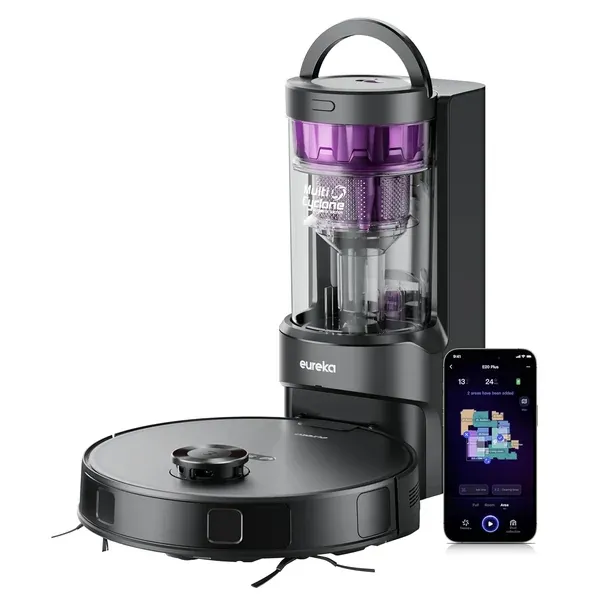
The Eureka E20 Plus is a robot vacuum and mop combination unit sold with a bagless self-emptying base station. According to Eureka's product pages, the robot delivers 8,000Pa of suction via a self-developed motor — a figure the manufacturer describes as a 100% improvement over the previous model. Navigation is handled by two front-mounted LiDAR Light Detecting Sensors (LDS), which Eureka says enable precise mapping and obstacle avoidance in low-light environments. The mopping module includes automatic carpet detection: upon sensing a rug, the mop pad lifts 10mm to avoid wetting carpet during cleaning passes, per Eureka's own product listing.
The self-emptying station uses a 13-cone multi-cyclonic separation system that the manufacturer claims separates 98% of dust and debris before it reaches the filter — eliminating the need for replacement dust bags and the ongoing cost that typically comes with bagged stations. The station holds up to 45 days of debris. App control is supported, though the unit only connects via 2.4GHz Wi-Fi; 5GHz networks are not supported.
Build Quality and Self-Emptying System
The bagless base station is a meaningful design choice. Where many self-emptying stations in this category use disposable bags — an ongoing consumable expense — the E20 Plus uses a transparent, bag-free collection system. Eureka notes that the bagless design can save users meaningfully on annual consumable costs compared to bag-based alternatives, though individual savings will vary based on usage frequency.
The anti-hair-tangle feature centers on a V-shaped rubber roller brush. Eureka states this design improves anti-wrap effectiveness by 14% compared to the previous brush, which is a modest but practical upgrade for pet owners dealing with regular hair accumulation.
Tech Advisor's published review of the E20 Plus describes the vacuum as "an efficient robot vacuum" and notes the 8,000Pa suction "should be enough to clean regular dirt, hair, crumbs, and whatever else you drop on the floor on any given day," while characterizing the mopping performance as "so-so" — a useful grounding for expectations on the wet-cleaning side.
Real-World Fit: Who It Suits, Who Should Skip
Based on the listing and published coverage, the E20 Plus is well-suited to:
- Pet owners and households with long hair, given the V-shaped rubber brush's anti-tangle focus.
- Buyers who want bagless convenience without the recurring cost of replacement bags.
- Homes with mixed hard floors and rugs, where the automatic mop-lift feature helps protect carpet.
- Users comfortable with app-based control and who have 2.4GHz Wi-Fi readily available.
Buyers may want to look elsewhere if:
- 5GHz-only or dual-band Wi-Fi setups won't easily fall back to 2.4GHz — the E20 Plus will not connect.
- Mopping performance is a priority. Third-party coverage from Tech Advisor rates the mopping as only adequate, which is a common limitation across robot mop combos in this tier.
- Maximum suction headroom matters. Eureka's own lineup already includes the E20 Evo Plus at 10,000Pa, a step up for users with heavy-debris environments.
How It Compares in the Eureka Lineup
Eureka's own product pages make it straightforward to situate the E20 Plus within the brand's range. The newer E20 Evo Plus — also a bagless self-emptying model — steps up to 10,000Pa suction and adds a Dragonclaw anti-tangle side brush. For buyers who don't need that extra suction headroom, the E20 Plus occupies the mid-range position with a well-rounded feature set. Both models share the bagless station philosophy.
Honest Limitations
Every product in this category carries trade-offs, and the E20 Plus is no exception:
- Mopping is secondary. Published coverage consistently positions the vacuum performance as the unit's strength and mopping as a convenience add-on rather than a replacement for dedicated wet cleaning.
- 2.4GHz only. In an era when many routers prioritize 5GHz, this is a genuine compatibility friction point worth confirming before purchase.
- Suction claims carry asterisks. The 100% suction improvement and 14% anti-tangle improvement figures appear with asterisks in Eureka's own materials, indicating they are comparative or controlled-condition claims rather than absolute guarantees.
- Readers reflect a mixed experience. The 3.9/5 aggregate from 755 Amazon ratings is a solid but not exceptional score, suggesting real-world results vary — a reasonable expectation for a mid-tier robotic vacuum.
Bottom Line
The Eureka E20 Plus makes a credible case for buyers seeking a bagless self-emptying robot vacuum at a mid-range price point. Its LiDAR navigation, high suction rating, and no-bag station design address the most common pain points in the category. The mopping capability is present but limited, and the 2.4GHz-only connectivity is a non-trivial constraint for some households. Readers rate it 3.9 out of 5 across 755 Amazon ratings — a fair reflection of a capable vacuum that stops short of excelling in every area it attempts to cover.
Darrell Steward
1 Feb, 2021Brilliant
This is the best product that has ever been made. It is also one of the best items in the world right now. Definitely go for it.
Albert Flores
17 Oct, 2020Just WOW
It's good to use this product for development as it has very good performance, display quality and all other features.