What It Is and Key Specs
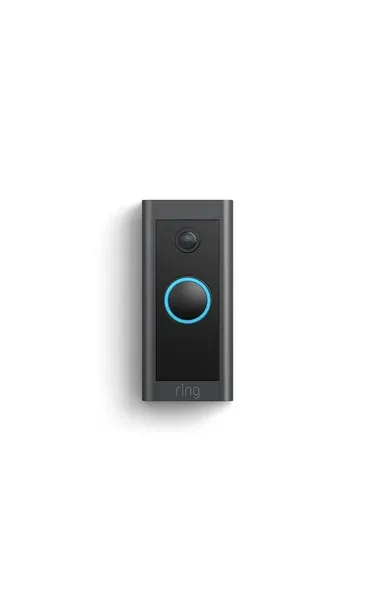
The Ring Video Doorbell Wired is Ring's entry-level hardwired doorbell camera — described by Ring itself as its smallest and most affordable model. It records in 1080p HD with night vision, supports two-way audio with noise cancellation, and connects via standard 2.4 GHz Wi-Fi. Advanced motion detection can alert you to activity before a visitor ever presses the button, and customizable privacy settings let users control what the camera monitors.
Because it draws power from existing doorbell wiring (an included tool kit supports installation), it offers continuous, around-the-clock operation — no battery swaps required. Real-time notifications are delivered to your smartphone, and the device integrates with Amazon Alexa: Echo Dot devices can announce visitors, while Echo Show can display a live video feed hands-free.
Build Quality and Safety
Per published manufacturer information, Ring positions this as a compact form factor relative to its other doorbell models. According to Ring's own support documentation, poor wiring or an incorrectly installed Pro Power Kit can contribute to issues such as video freezing and night vision problems — a reminder that clean, correct wiring is foundational to stable performance.
On the safety front:
no CPSC recalls are on record for Ring products of this type as of 2026-07-24 (
saferproducts.gov).
Real-World Fit
This doorbell suits homeowners or renters (with landlord permission) who already have low-voltage doorbell wiring in place and want a straightforward, always-powered camera at a budget-tier price point. Its Alexa compatibility makes it a natural fit for households already invested in Amazon's ecosystem.
Who should skip it: anyone without existing doorbell wiring — this model requires it, full stop. Buyers who want their existing in-wall chime to keep working should also look elsewhere. As Consumer Reports noted in its coverage, this model does not work with a home's existing doorbell chime; instead, users must purchase a Ring Chime (sold separately) or route notifications through a compatible Alexa device or Echo speaker. That's an added cost and logistical step that some competing video doorbells in this category avoid.
Those who prioritize higher video resolution should also temper expectations: Ring's own lineup now extends to 1536p HD+ and, in its newer 2025 models, up to 4K resolution, per CNET's coverage of the best Ring video doorbells. The Wired sits at the base of that resolution ladder.
How It Compares in Its Category
Within Ring's own doorbell lineup, this model trades video resolution and advanced features for a lower price and compact size, according to Ring's product collection page. PCMag describes it as Ring's smallest and most affordable model — useful framing for shoppers weighing entry-level access against more capable (and more expensive) tiers. SafeHome.org's broader Ring review coverage notes that some Ring doorbells are now available in wireless configurations with 2K resolution, which may appeal to buyers who lack existing wiring or want higher image clarity.
Honest Limitations
Several real-world friction points are worth noting, all grounded in published sources:
- No existing chime support. The doorbell will not trigger your home's built-in chime — a notable inconvenience flagged by Consumer Reports. An add-on chime or Alexa device is required for in-home audio alerts.
- 2.4 GHz only. The single-band Wi-Fi connection can be a bottleneck in dense wireless environments. Ring's own troubleshooting documentation acknowledges that weak Wi-Fi signals and network health issues are common sources of device problems, including going offline.
- Wiring dependency. Stable operation depends on correct low-voltage wiring. IFixit's troubleshooting documentation specifically links poor wiring to video freezing and night vision failures.
- Subscription required for full functionality. Reviewing recorded footage and accessing intelligent alerts requires a Ring Protect plan, sold separately. Without it, the device functions only as a live-view and motion-alert tool.
- Resolution ceiling. At 1080p, it delivers a functional but not class-leading picture compared to newer Ring models and some competitors in the broader doorbell camera market.
Darrell Steward
1 Feb, 2021Brilliant
This is the best product that has ever been made. It is also one of the best items in the world right now. Definitely go for it.
Albert Flores
17 Oct, 2020Just WOW
It's good to use this product for development as it has very good performance, display quality and all other features.