What It Is and Key Specs
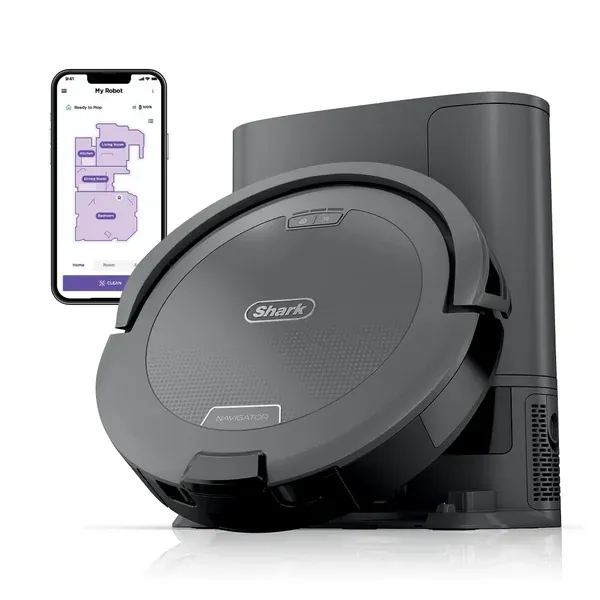
The Shark Navigator Robot Vacuum with Self-Empty Base (model RV2100AE, Dark Grey) is a mid-to-upper-tier robot vacuum designed for carpets and hard floors. Its headline technology is SmartPath Navigation, which uses spot LiDAR to map the home and clean in a row-by-row pattern rather than the randomized bouncing approach found in older-generation robots. According to Shark's manufacturer information, this yields up to 1.5x more coverage compared to the Shark ION line.
Suction is rated at up to 50% more than a competitor robot vacuum (the exact competitor is unspecified in the listing). The self-cleaning brushroll is engineered to be anti-hair wrap, which is a meaningful spec for pet owners — hair tangles around brushrolls are one of the most common maintenance headaches in this category.
The self-empty base holds up to 60 days of dirt and debris and is bagless, meaning no ongoing purchase of disposal bags — a distinction SharkNinja's own product page specifically calls out as differentiating it from traditional auto-empty systems. In the box: the robot itself, the self-empty base, and one side brush.
App control and voice control are supported, enabling whole-home, room-level, or spot cleaning on demand. A recharge-and-resume feature allows the robot to dock when the battery runs low and pick up where it left off.
---
Build Quality and Safety
Shark's anti-hair wrap brushroll technology is a deliberate engineering choice, not a passive feature — the brushroll is designed to actively shed hair rather than accumulate it around the axle. The self-cleaning mechanism is intended to reduce how often owners need to manually clear the brush.
The self-empty base's bagless design eliminates one recurring cost, but it also means the base bin and filter require periodic manual attention. Published troubleshooting guidance from Trunetto notes that self-empty failures on Shark bases are almost always traceable to a clog in the base suction path, a full base bin, a choked base filter, or the robot not seating squarely on the docking contacts — all of which are owner-serviceable issues, but worth knowing upfront.
CPSC safety information was not included in the available sources for this product and is therefore omitted from this review.
---
Real-World Fit: Who It Suits, Who Should Skip
Good fit for:- Pet owners dealing with hair on both carpet and hard floors, given the anti-hair wrap brushroll and stated powerful suction.
- Households that want genuinely hands-free operation over extended periods — the 60-day base capacity and recharge-and-resume mean the robot can run unsupervised for weeks at a stretch.
- People who want to avoid the recurring cost of disposal bags that bagless self-empty alternatives in this class typically charge for.
- Those who prefer structured, mapped cleaning over random-pattern coverage.
May not be the best fit for:- Very cluttered spaces. While the robot's object detection and avoidance is listed as a feature, a heavily obstructed floor will still challenge navigation efficiency.
- Buyers who want the absolute lowest maintenance experience — the bagless base bin and filter still require periodic emptying and cleaning, and self-empty errors do occur (see limitations below).
---
Honest Limitations
No product in this category is without trade-offs, and the RV2100AE is no exception.
- Self-empty reliability requires owner diligence. According to published troubleshooting sources, self-empty failures are a documented pattern across Shark's self-empty lineup. Clogs, full bins, and dirty filters are the primary culprits — the 60-day claim assumes optimal, real-world conditions, which may vary by home and debris load.
- The suction and coverage comparisons are relative, not absolute. The "50% more suction" claim is versus an unnamed competitor, and the "1.5x more coverage" is versus Shark's own ION series — shoppers comparing against other current-market robots should weigh these numbers carefully.
- Error recovery can require manual intervention. Published error-code guidance notes that some self-empty base failures require a force restart (holding CLEAN and DOCK simultaneously for 10 seconds) or, in persistent cases, a factory reset — steps that undercut the hands-free promise if they occur frequently.
- One side brush included. Replacement brushes are an additional purchase when the included brush wears down.
---
Category Context
Robot vacuums with self-empty bases have become a crowded segment. The bagless approach Shark uses here is less common — most competitors in this tier still rely on bagged collection in the base — which gives the RV2100AE a meaningful cost-of-ownership advantage over time, assuming the base filter and bin are maintained regularly. The spot LiDAR navigation positions this model above entry-level random-pattern robots but, as with all LiDAR-equipped models, initial mapping runs and occasional remapping after furniture changes are part of the ownership experience.
Darrell Steward
1 Feb, 2021Brilliant
This is the best product that has ever been made. It is also one of the best items in the world right now. Definitely go for it.
Albert Flores
17 Oct, 2020Just WOW
It's good to use this product for development as it has very good performance, display quality and all other features.