What It Is and Key Specs
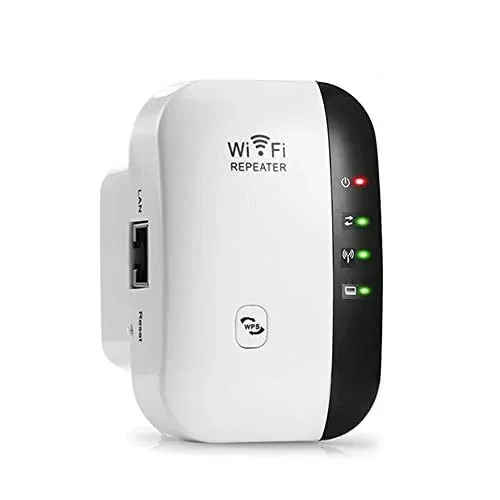
The grecab WiFi extender is a wall-plug wireless repeater designed to push an existing router's signal into dead zones. According to the manufacturer, it covers up to 5,000 sq. Ft. And supports up to 45 connected devices simultaneously. It operates on a single 2.4 GHz band, delivering speeds up to 300 Mbps (N300 class). The unit includes a Fast Ethernet port for a wired backhaul connection, two operating modes (Repeater and Access Point), and WPS one-touch pairing alongside a browser-based setup option. The manufacturer states it is compatible with roughly 99% of routers and gateways on the market and works with iOS, Android, Amazon Echo/Alexa, PlayStation, smart plugs, and more.
Build Quality and Design
The extender uses a plug-in wall design with built-in vent holes — a detail the manufacturer specifically calls out for thermal management. The compact, outlet-mounted form factor makes it easy to reposition around the home and, per the listing, is also practical for travel. Security protocols supported include WEP and WPA/WPA2, which are standard for this product tier. There are no CPSC recall notices or safety advisories associated with this product in the sources reviewed.
Real-World Fit: Who It Suits and Who Should Skip It
This extender is most likely to satisfy users dealing with a specific, contained dead zone — a back bedroom, a garage, or a basement — where a 2.4 GHz signal can reach but the router's coverage falls short. The 2.4 GHz band trades raw speed for longer range and better wall penetration, which suits browsing, smart-home devices, security cameras, and standard-definition or HD video streaming. The onboard Ethernet port is a meaningful inclusion: connecting the extender to a router via cable (rather than relying on a wireless backhaul) generally produces more stable throughput, and the manufacturer highlights this as a way to avoid speed drops.
Households with heavier demands — 4K streaming on multiple screens, low-latency gaming, or a large home with many simultaneous users — may find the single-band N300 specification limiting. Independent testing organizations such as Wirecutter, PCMag, Consumer Reports, and TechGearLab consistently evaluate extenders on throughput at near and far range; this unit's 300 Mbps theoretical maximum puts it in the entry-level tier, where real-world speeds are typically a fraction of the headline figure, as is common across this class of device. Shoppers with those heavier workloads may want to compare against Wi-Fi 6 extenders or mesh systems before committing.
Setup and Compatibility
The manufacturer describes two paths to setup: pressing the WPS button on the existing router for a one-tap pairing, or using a browser-based configuration page accessible from virtually any device. The plug-and-play wall design requires no separate power adapter. Repeater Mode extends an existing wireless network, while AP (Access Point) Mode converts a wired connection into a wireless one — a useful distinction if you have an Ethernet run to a room but no wireless coverage there.
Honest Limitations
A few practical caveats are worth flagging before purchase. First, the headline 5,000 sq. Ft. Coverage figure represents an ideal-condition maximum; walls, floors, appliances, and the placement of the extender relative to the router all affect real-world range, as is typical of range claims across this product category. Second, at 300 Mbps (2.4 GHz only), there is no 5 GHz band for devices that benefit from shorter-range, higher-speed connections. Third, the readers' aggregate of 3.8 out of 5 from 3,484 Amazon ratings suggests a broadly satisfactory but not universally trouble-free experience — a pattern common with extenders generally, where placement sensitivity and router compatibility can affect individual results. Firmware and placement adjustments are the most commonly cited remedies when extenders underperform, a point echoed across general troubleshooting resources in this category.
Bottom Line
The grecab WiFi extender is a straightforward, entry-level solution for extending a 2.4 GHz signal into hard-to-reach areas of a home. Its Ethernet port, dual operating modes, and broad router compatibility give it more flexibility than the bare minimum in its class. The single-band, N300 specification is the clearest ceiling on its capability, and prospective buyers should weigh that against their actual usage before purchasing. The 3.8/5 readers' aggregate from over 3,400 ratings reflects a product that works for many users in the right context — but that context matters.
Darrell Steward
1 Feb, 2021Brilliant
This is the best product that has ever been made. It is also one of the best items in the world right now. Definitely go for it.
Albert Flores
17 Oct, 2020Just WOW
It's good to use this product for development as it has very good performance, display quality and all other features.