What It Is and Key Specs
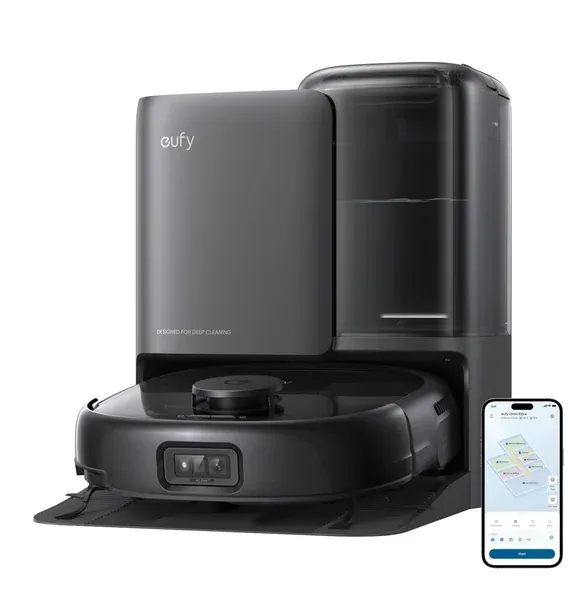
The eufy E25 is a robot vacuum and mop combo built around the brand's HydroJet™ system — described by eufy as a world-first in the category. The headline specifications include 20,000 Pa of suction power, a 125-minute runtime in standard vacuum-plus-mop mode, and laser-guided navigation capable of storing up to five floor plans with automatic floor switching. The robot operates at or below 61 dB in max mode, which eufy positions as suitable for large, multi-room homes.
The all-in-one station handles auto-emptying into a 3-liter dust bag (rated for approximately 75 days between changes), self-washing and hot-air drying of the roller mop at 50°C, and automatic water refilling. The CornerRover extendable side arm is designed to reach baseboards, furniture legs, and tight corners, while a 10.8 mm mop lift protects carpets and a 21 mm climbing height handles most doorway thresholds. Connectivity is 2.4 GHz Wi-Fi only — no 5 GHz support — and the robot is compatible with Alexa, Google Assistant, and Siri via the eufy app. Setup is advertised as requiring no drilling and approximately five minutes.
Build Quality and the HydroJet Mopping System
The HydroJet system refreshes the roller mop twice per second with clean water, a design choice intended to prevent cross-contamination and address dried-on stains like coffee and sauces. The DuoSpiral anti-tangle main brushes are a notable hardware update. Vacuum Wars notes the E25 sits at the higher end of the mid-tier price range and is positioned as a value-minded option relative to flagship competitors. Vacuum Chef's published review found the DuoSpiral detangle rollers to be "a major step forward" and "a long overdue upgrade for Eufy," handling crumbs, dirt, dust, and pet hair without hesitation during their coverage.
The all-in-one station's hot-air drying at 50°C addresses a common concern with robot mops — wet roller pads left to sit can develop odor — and the automatic water refill loop completes what eufy markets as a genuinely hands-free system for up to 68–75 days between manual interventions.
Real-World Fit: Who It Suits, Who Should Skip
The E25 is a reasonable fit for larger homes with a mix of hard floors and low-to-medium pile carpet, particularly households with pets that deal with ongoing hair management. The anti-tangle brush design and 20,000 Pa suction are specifically oriented toward that use case, and the multi-floor plan memory (up to five) suits multi-story homes. The 2.4 GHz-only Wi-Fi requirement is a practical consideration for anyone whose router or mesh network defaults devices to 5 GHz bands.
Buyers who prioritize the absolute highest-tier mapping intelligence or the most advanced obstacle avoidance should note that, per Trusted Reviews, the E25 "does lack some of its rivals' more advanced features" compared to flagship-tier models. It is transparently a mid-tier product with mid-tier trade-offs.
How It Compares in Its Category
Vacuum Wars characterizes the E25 as "value-minded" relative to many competitors, offering a solid feature set — roller mop with self-cleaning, high suction, anti-tangle rollers, all-in-one station — at a price point below the top-tier market leaders. Trusted Reviews describes it as "a great mid-range robot vacuum and mop" and "a very powerful robot and a decent mopper." That framing — strong on vacuuming, capable but not class-leading on mopping — appears consistent across published coverage.
Honest Limitations
The most significant concern surfaced in published coverage comes from Lifehacker, whose reviewer documented a recurring mid-run shutdown issue: "On each run, consistently, the robot would stop in the middle of my floor and turn off." Lifehacker also flagged an operational constraint worth knowing upfront: the robot can only be powered on from its dock, which can become a practical problem if the unit stops away from the station. That reviewer noted their unit ended up "sitting" as a result of the issue.
The 2.4 GHz-only Wi-Fi limitation may require router configuration for some users. The dust bag, while rated for roughly 75 days, is a consumable cost to factor into long-term ownership. And while the mop refresh rate is a genuine differentiator, Trusted Reviews' characterization of mopping as "decent" rather than exceptional suggests buyers with heavy mopping demands may want to calibrate expectations accordingly.
Reader Sentiment
Across more than 53,800 Amazon ratings, readers award the E25 a 4.4 out of 5 aggregate — a strong signal of broad satisfaction at scale, though individual experiences, as Lifehacker's coverage illustrates, can vary meaningfully.
Darrell Steward
1 Feb, 2021Brilliant
This is the best product that has ever been made. It is also one of the best items in the world right now. Definitely go for it.
Albert Flores
17 Oct, 2020Just WOW
It's good to use this product for development as it has very good performance, display quality and all other features.