What It Is and Key Specs
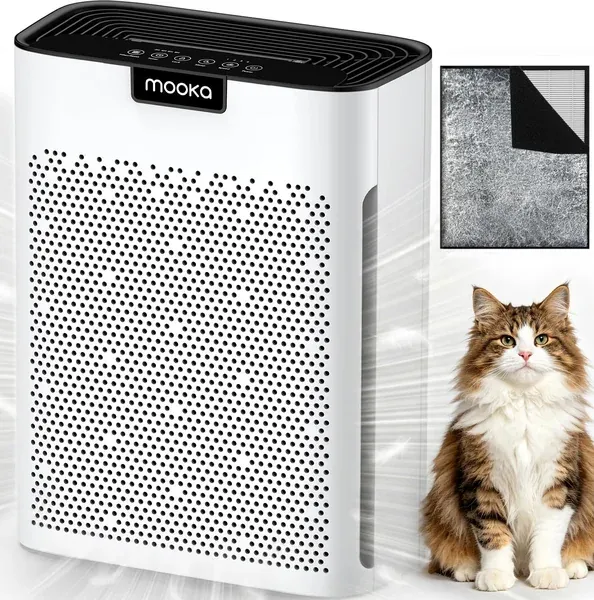
The MOOKA KJ190H is a tower-style air purifier rated by the manufacturer to clean spaces up to 2,200 sq ft per hour. It uses a 3-stage filtration system: a washable pre-filter, an H13 True HEPA layer, and an activated-carbon pellet stage for odor absorption. A built-in PM2.5 sensor feeds a real-time AQI display, and Auto Mode adjusts fan speed based on that reading automatically.
Other headline specs from the listing:
- 4 fan speeds plus Sleep Mode (rated at 20 dB) and Auto Mode
- Timer options of 2, 4, 6, or 8 hours
- Energy consumption: 0.63 kWh per 24 hours at maximum speed, per the manufacturer
- Filter reminder at 2,000 hours of use
- Aromatherapy pad for optional essential oil use
- Child lock included
- Certifications listed: CARB, ETL, DOE; manufacturer states no ozone release and no UV light
The multi-inlet design — a larger front intake plus dual side intakes — is positioned specifically for capturing pet hair and airborne dander more efficiently than single-inlet alternatives, according to the product listing.
Build Quality and Safety
MOOKA lists CARB, ETL, and DOE certifications for the KJ190H, and the manufacturer explicitly states the unit releases no ozone and uses no UV light, which Consumer Reports' buying guidance identifies as relevant safety considerations for air purifier shoppers.
CPSC note: The Consumer Product Safety Commission has issued recalls against other air purifier models in this category — most recently Airova/Aroeve units cited for fire and burn hazards (
cpsc.gov). As of July 24, 2026, no CPSC recall has been identified that names this specific MOOKA model, but that should not be read as a verified all-clear. Shoppers should periodically check
cpsc.gov for updates on any air purifier they own.
The washable pre-filter is a genuine practical feature: keeping large debris from reaching the HEPA layer extends its service life and reduces replacement frequency. The listing advises removing the protective plastic bag from the filter before first use — a detail worth flagging, as overlooking it would render the filtration inert.
Real-World Fit: Who It Suits, Who Should Skip
The KJ190H looks well-matched for:
- Pet households in larger open-plan spaces — the multi-inlet design and activated carbon stage address both airborne hair and odors, the two most common complaints in pet-owner reviews of this category.
- Light sleepers — a 20 dB Sleep Mode with dimmed lights is genuinely low for a tower unit at this coverage rating.
- Energy-conscious buyers — 0.63 kWh per 24 hours at max speed is modest by category standards.
- Those who want hands-off operation — the PM2.5 Auto Mode removes the need to manually adjust speeds as air quality shifts.
It is a less obvious fit for:
- Shoppers seeking app or remote control — none is mentioned in the listing or available sources.
- Those wanting a certified CADR figure verified by an independent lab — the 2,200 sq ft claim comes from the manufacturer and no third-party test data for this specific model appeared in published roundups from Wirecutter, Consumer Reports, HouseFresh, or RTINGS at the time of this review.
- Buyers in very small rooms who run the unit at low speed permanently and would rarely benefit from the larger-room coverage rating.
Category Context
Independent roundups from Wirecutter and Consumer Reports consistently highlight Coway models as benchmarks in the value-to-performance tier, noting quietness, energy efficiency, and verified CADR scores. The MOOKA KJ190H does not appear in those roundups, which limits direct performance comparisons. That absence is not itself a negative judgment — the category is large — but buyers who prioritize third-party-verified airflow data should note it.
Consumer Reports' buying guidance confirms that H13 HEPA filters — certified to capture 99.97% of particles at 0.3 microns — are among the most effective available for residential use. The KJ190H's H13 designation aligns with that standard as stated by the manufacturer.
Honest Limitations
- No independently verified CADR: The 2,200 sq ft/hour figure is a manufacturer claim. Real-world coverage depends on ceiling height, room layout, and how often doors open — factors no lab rating can fully replicate either, but a published CADR provides a useful baseline that is absent here.
- Replacement filter costs are ongoing: The 2,000-hour reminder is a helpful feature, but filter expenses accumulate over time. The washable pre-filter mitigates this partially but does not eliminate it.
- No app or smart-home integration: The Auto Mode provides automation, but there is no remote scheduling, usage tracking, or voice-assistant compatibility mentioned anywhere in the listing.
- Aromatherapy pad requires priming: The listing notes the cotton pad must be moistened with "ample essential oil" on first use for the feature to function — a minor but real onboarding step.
- CPSC landscape: Recall activity in the broader air purifier category (not this unit specifically) warrants ongoing attention from any air purifier owner regardless of brand.
Darrell Steward
1 Feb, 2021Brilliant
This is the best product that has ever been made. It is also one of the best items in the world right now. Definitely go for it.
Albert Flores
17 Oct, 2020Just WOW
It's good to use this product for development as it has very good performance, display quality and all other features.