What It Is and Key Specs
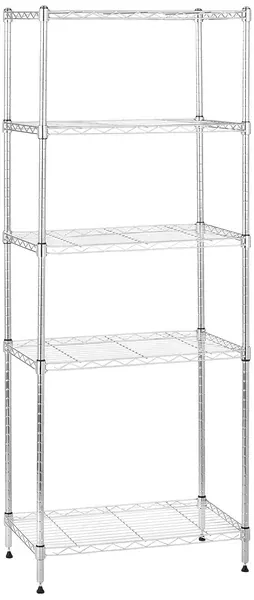
The Amazon Basics 5-Shelf Adjustable Shelving Unit is a steel wire rack finished in chrome, sized at 23.2 inches long by 13.4 inches wide by 60 inches tall. Each of the five shelves is rated to hold up to 200 pounds of evenly distributed weight, putting the total unit capacity at 1,000 pounds. Shelf heights are adjustable in 1-inch increments, and four leveling feet are included to compensate for uneven floors. Assembly requires no tools, according to the manufacturer. This review synthesizes the product listing and manufacturer-provided information.
Build Quality and Materials
The unit is constructed from durable steel with a chrome finish — a combination common across this tier of wire shelving that offers corrosion resistance suitable for garages and laundry rooms where humidity can fluctuate. The wire-grid shelf design, typical of this category, promotes airflow and allows visibility of stored items at a glance. The 200-pound-per-shelf rating is a notable figure for a unit in this class, though that number assumes weight is evenly distributed across the shelf surface rather than concentrated at a single point — an important distinction for heavy or awkwardly shaped items.
The four leveling feet are a practical inclusion: on concrete garage floors or older kitchen tiles, minor surface irregularities are common, and adjustable feet help prevent wobble without shimming.
Real-World Fit
Based on the manufacturer's listed use cases — garage, laundry room, kitchen, playroom, and other living or work spaces — this shelving unit is designed to be a generalist rather than a specialist. At roughly 13.4 inches deep, it suits lighter-footprint storage: canned goods, cleaning supplies, power tools, bins, and folded textiles all fall naturally within that depth. The 60-inch height provides meaningful vertical storage without requiring a step stool for the top shelf in most settings.
The no-tools assembly claim and 1-inch-increment adjustability make it accessible for solo setup and reconfiguration over time — useful when storage needs shift seasonally or across a move.
Who it suits: Households needing affordable, multi-room shelving with meaningful load capacity and the flexibility to reconfigure. Renters who want a unit they can adapt and take with them will find the tool-free design particularly practical.
Who should consider alternatives: Those needing deep shelving for large bins, bulky equipment, or very wide spans may find the 13.4-inch depth limiting. Buyers seeking a fully enclosed or solid-shelf unit — for fine dust protection or aesthetics in a finished living space — should look elsewhere, as the open wire design is functional rather than decorative.
How It Lands in Its Category
Wire shelving in this tier is a crowded space, and the Amazon Basics unit competes primarily on price accessibility and the credibility of its load ratings. A 200-pound-per-shelf rating is competitive for the category. The chrome finish places it a step above basic epoxy-coated wire racks aesthetically, while remaining well below stainless or powder-coated premium alternatives in cost.
The reader aggregate of 4.6 out of 5 from 262,495 Amazon ratings suggests strong satisfaction at scale — a sample size large enough to be meaningful rather than self-selected enthusiasm.
Honest Limitations
No product at this price point is without trade-offs, and wire shelving as a category carries a few consistent ones. The open-wire surface can leave marks on soft items resting directly on it and allows small objects to fall through gaps — shelf liners are a common third-party addition buyers should budget for. The 13.4-inch depth is genuinely narrow compared to garage shelving designed for large totes or equipment. Additionally, while the unit holds up to 1,000 pounds in total, that load must be distributed thoughtfully across all five shelves; the rack's footprint — roughly 23 by 13 inches — means it won't anchor a heavy, top-loaded configuration as securely as a wider, deeper unit would. Buyers with very heavy concentrated loads should verify their specific use case against the evenly distributed weight rating.
Darrell Steward
1 Feb, 2021Brilliant
This is the best product that has ever been made. It is also one of the best items in the world right now. Definitely go for it.
Albert Flores
17 Oct, 2020Just WOW
It's good to use this product for development as it has very good performance, display quality and all other features.