What It Is and Key Specs
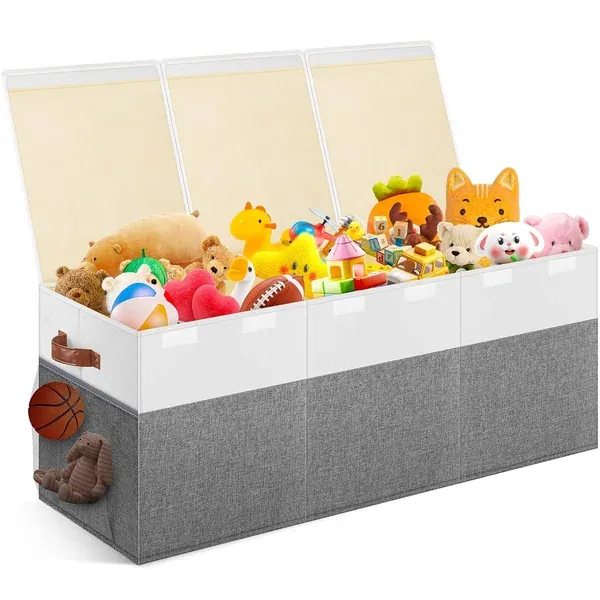
The LuvemHome Extra Large Toy Box is a collapsible storage chest measuring 40"×14"×16" with a stated capacity of 150 liters — proportions that place it firmly in the oversized category for home storage bins. The exterior is finished in a White & Gray colorway designed to blend with contemporary nursery or bedroom décor.
Structural support comes from thickened PP (polypropylene) cardboard — specifically 3mm high-quality PP board — wrapped in a 100% linen fabric shell. The manufacturer describes the fabric as odorless and non-toxic, with non-irritating properties suited to children's spaces. A flip-top lid keeps dust off stored items, and reinforced handles on each side allow the chest to be carried from room to room when loaded.
Additional features include:
- Two side mesh pockets for small accessories
- Two removable divider boards secured by Velcro, which can be reconfigured or removed entirely for bulkier items
- Full flat-fold collapse when the bin is not in use
Build Quality and Materials
According to manufacturer specifications, the 3mm PP board walls are rated to withstand 30–50 kg of weight, which the listing characterizes as sufficient to prevent sidewall deformation under normal household loads. The linen outer layer is positioned as breathable, a practical property for storing items like clothes or stuffed animals that benefit from some airflow.
The Velcro-attached divider system keeps internal organization flexible without tools, and the mesh side pockets add small-item storage that the main compartment is too large to organize efficiently on its own. Readers' aggregate sentiment backs up the structural claims to a meaningful degree — the chest holds a 4.4/5 score from 247 Amazon ratings — though individual experiences with fabric-and-cardboard constructions can vary based on load and handling habits.
Real-World Fit — Who It Suits, Who Should Skip
This chest is well matched to households with young children who accumulate large volumes of plush toys, building blocks, books, and dress-up items. The 150-liter interior is large enough, per the listing, to hold a substantial collection of stuffed animals or blankets in a single container, reducing the number of separate bins needed. The flat-fold feature makes it practical for seasonal or occasional use — it can be stored flat in a closet between holiday gift overflow or back-to-school periods.
The 40-inch length is a significant footprint consideration. Shoppers with compact playrooms or limited floor space should measure carefully before purchasing. Fabric-and-PP-board construction, while lightweight and collapsible, is a different category than hard-shell wooden toy chests; buyers expecting rigid, furniture-grade durability may find this format underwhelming over years of heavy use. It is also worth noting that this style of bin is typically not rated for children to sit on, and the lid is a flip-top rather than a slow-close hinge — a safety consideration worth weighing in households with very young children.
Versatility Beyond the Playroom
The manufacturer lists a broad range of intended uses: living rooms, bedrooms, utility rooms, nurseries, dormitories, and hallways. The neutral White & Gray palette supports this flexibility, and the ability to remove the divider means the same bin that organizes toys today can store blankets, shoes, or seasonal clothing later. The side mesh pockets add utility for TV remotes, small books, or craft supplies in non-playroom settings.
Honest Limitations
- Footprint is substantial. At 40 inches wide, this is not a compact solution — floor space planning is essential.
- Fabric construction has inherent trade-offs. Linen and PP board are lighter and more foldable than wood or hard plastic, but they are generally less resistant to rough handling, sharp edges on toys, or repeated heavy loading over time.
- Flip-top lid, not slow-close. Parents of toddlers should note the lid does not have a safety hinge; unsupported lids can fall quickly.
- Velcro dividers may shift. Velcro attachment is convenient but can lose grip over time with repeated repositioning, particularly under heavier loads.
Darrell Steward
1 Feb, 2021Brilliant
This is the best product that has ever been made. It is also one of the best items in the world right now. Definitely go for it.
Albert Flores
17 Oct, 2020Just WOW
It's good to use this product for development as it has very good performance, display quality and all other features.