What It Is and Key Specs
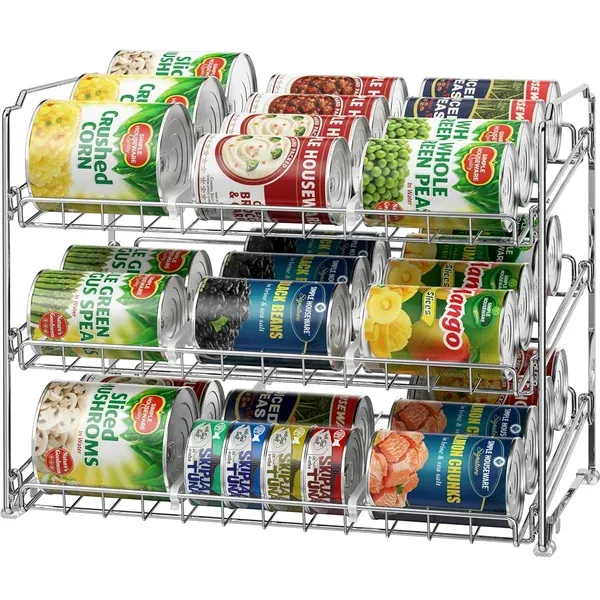
The Simple Houseware 3-Tier Stackable Can Organizer Rack is a chrome-coated metal shelf system designed to store and dispense up to 36 standard cans. Its physical footprint is 11.5" D × 17" W × 13.75" H, but the manufacturer is explicit in its listing: the surrounding space must be at least 12" D × 17.5" W × 16" H to accommodate the rack comfortably — a spec worth measuring before ordering.
Shelves are angled to let cans roll forward automatically, enabling a first-in, first-out system that keeps older stock at the front. Six movable plastic dividers are included to separate different can or jar sizes across the three tiers. The unit is also stackable: plastic clips allow two or more racks to connect vertically for expanded storage without additional floor space. Anti-slip rubber feet keep the freestanding unit stable on pantry shelves, cabinet floors, countertops, or the floor itself. The design carries USPTO Patent No. US10051979B2.
Build Quality and Safety
The frame is chrome-coated steel — a material choice that trades the warmth of wood or plastic for corrosion resistance and rigidity. Assembly requires no hardware and no tools; published roundup coverage at
mayfairfarms.com notes the unit can be assembled and loaded with 30 cans in under five minutes, consistent with the manufacturer's "assembles in a minute" claim. The plastic clips and dividers are the only non-metal components, and their durability over time is something individual buyers should factor in if they plan to reconfigure dividers frequently.
On safety: as of July 24, 2026, there are no CPSC recalls on record for Simple Houseware products of this type, per
saferproducts.gov.
Real-World Fit — Who It Suits, Who Should Skip
This rack earns a practical recommendation for households that stockpile canned goods, keep a rotating supply of soda cans, or want to impose first-in, first-out discipline on a crowded pantry. Published roundup coverage at
progressiveradionetwork.com positions it as a strong choice for proven reliability backed by a substantial volume of buyer reviews.
That said, the rack is not a universal fit. At 17" wide and requiring 17.5" of clearance, it will not slide into a standard narrow cabinet shelf without measurement first. The manufacturer flags this dimension prominently — it's the first bullet in the listing — and buyers who skip that step risk a return. Those with compact pantry setups or shallow cabinet depths should look elsewhere or consider a smaller-capacity alternative.
The stackable design is genuinely useful for growing pantries: adding a second unit on top of the first keeps the combined system contained to the same footprint. However, stacking height will be a ceiling constraint in lower cabinets.
Honest Limitations
- Size demands upfront planning. The rack's width and depth are on the larger end for this category. The required clearance (12" D × 17.5" W × 16" H) exceeds the rack's own dimensions, so buyers in tight spaces may find the fit impractical even when the numbers look close on paper.
- Plastic dividers and clips. The six included dividers and the stacking clips are plastic in an otherwise all-metal product. Their longevity under heavy or frequent reconfiguration is not addressed in available sources.
- No weight capacity listed. The manufacturer does not publish a maximum load rating in the listing. Buyers storing heavy mason jars across all three tiers should factor this uncertainty into their decision.
- Visibility of contents. The chrome-rack design means cans behind the front row are not always visible at a glance — the roll-forward mechanism helps, but labeling or grouping by type remains the buyer's organizational responsibility.
Category Context
Published roundup coverage — including lists compiled as recently as July and August 2026 — consistently places this rack among top picks in the pantry can organizer category, citing its no-tool assembly and first-in, first-out functionality as standout features. This review synthesizes the product listing, manufacturer information, and that published coverage; it does not reflect hands-on installation by LuvemHome editorial staff.
Darrell Steward
1 Feb, 2021Brilliant
This is the best product that has ever been made. It is also one of the best items in the world right now. Definitely go for it.
Albert Flores
17 Oct, 2020Just WOW
It's good to use this product for development as it has very good performance, display quality and all other features.