What It Is and Key Specs
The Honeywell HWT-H6 is a freestanding LED desk lamp rated at 800 lumens and powered by 108 Sunturalux full-spectrum LED beads. It ships in gray and offers three color temperature modes — warm (3000K), natural (4000K), and white (5000K) — each paired with seven brightness steps (15%, 30%, 45%, 60%, 75%, 90%, and 100%), yielding 21 distinct lighting combinations in total.
A built-in ambient light sensor reads surrounding brightness and adjusts output automatically, which is a feature more commonly found on premium monitors than desk lamps at this price tier. Touch controls handle mode switching, and a 45-minute auto-off timer is included for focus sessions or bedtime reading. According to the manufacturer, LED lifespan exceeds 30,000 hours.
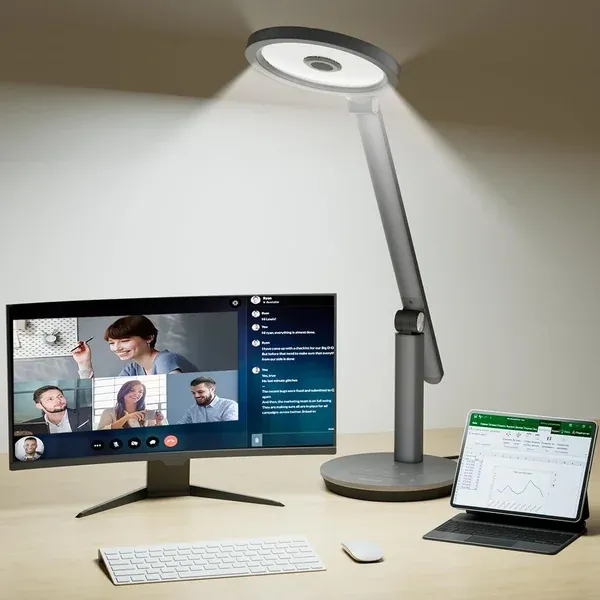
The lamp head emits light from both the top and bottom via a three-dimensional diffuser and a circular light-diffusing panel. The arm and head each offer 180° of vertical and horizontal movement, and the base is described as a sturdy metal construction — aluminum, zinc alloy, and other premium materials per the listing.
Build Quality and Safety
The H6's chassis combines aluminum and zinc alloy, materials the manufacturer says are chosen for durability and heat dissipation — a point Honeywell's own coverage of the similar H4 model reinforces, noting that aluminum alloy bodies "prevent overheating over long hours." The metal base is described as adding stability, which matters for a tall reading lamp that may be repositioned frequently.
On the eye-safety side, the H6 carries RG0 certification (no blue light hazard class) and a double anti-glare design. Its CRI is rated at ≥97, meaningfully above the CRI 80–90 range typical of standard desk lamps — a specification Honeywell highlights across its Sunturalux line and that independent coverage of other models in the family corroborates as a consistent design priority. The manufacturer's blog also references TÜV-certified flicker-free operation for the H6, relevant for users logging extended screen time.
No CPSC recalls are on record for Honeywell products of this type as of July 24, 2026 (
saferproducts.gov).
Real-World Fit: Who It Suits, Who Should Skip
The H6 is designed with several distinct use cases in mind. The listing explicitly calls out home office work, Zoom and video-conference lighting, live streaming, studying, and makeup application — all tasks where accurate color rendering matters. At CRI ≥97, colors under this lamp should appear close to how they look in natural daylight, which is genuinely useful for makeup, graphic work, or any task where color fidelity is important.
The circular diffuser panel also makes it compatible with circle webcams — an unusual but practical design touch for hybrid workers who want clean on-camera lighting without a separate ring light. Honeywell's own blog review of the H6 notes it can substitute for a ring light for makeup, citing the high CRI as the deciding factor.
The 45-minute timer and ambient sensor add a passive wellness angle that suits students or readers who don't want to manually manage their light environment. The foldable, adjustable design makes storage or travel between rooms reasonably straightforward.
Who should consider alternatives: buyers who need a clamp-mount solution (the HJ1 in Honeywell's lineup addresses that), those who require higher raw output (the HJ1 delivers 1,200 lumens versus the H6's 800), or anyone who needs floor-level ambient room coverage rather than focused task lighting.
Honest Limitations
The H6's 800-lumen ceiling is adequate for a personal task zone but will not light a full room — a tradeoff Honeywell's own coverage of its floor lamp line acknowledges as the reason some users move away from desk lamps entirely. The 45-minute timer is a single fixed interval; users who want a shorter or longer auto-off window have no adjustment. The listing also includes a notable caveat — "please note the size before buying" — suggesting the lamp's footprint or height may surprise buyers who don't check dimensions carefully before purchase. Finally, the ambient sensor automates brightness adjustments, which is a convenience for most users but a potential frustration for anyone who prefers manual-only control and finds the sensor overriding their settings.
Darrell Steward
1 Feb, 2021Brilliant
This is the best product that has ever been made. It is also one of the best items in the world right now. Definitely go for it.
Albert Flores
17 Oct, 2020Just WOW
It's good to use this product for development as it has very good performance, display quality and all other features.