What It Is and Key Specs
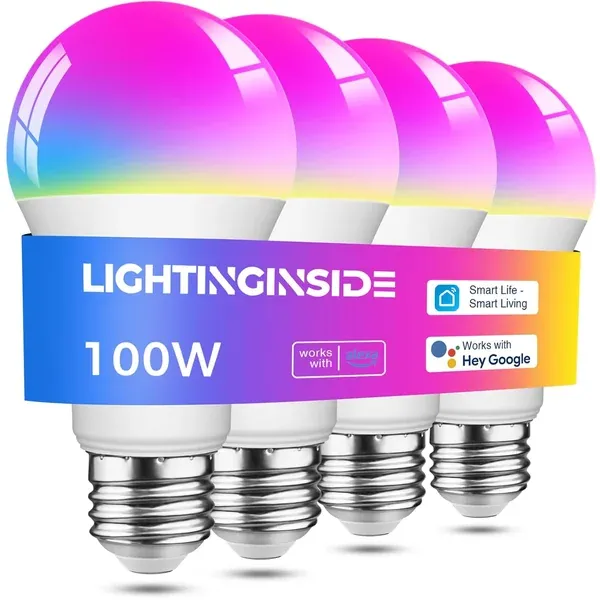
The Lightinginside Smart Light Bulbs are A19-shaped, E26-base LED bulbs sold in a four-pack. According to the product listing, each bulb draws 11 watts while delivering 1,350 lumens — a 100W incandescent equivalent — and operates on 110–130V AC. The color range spans 16 million RGB colors alongside a tunable white spectrum from 2,700K (warm white) to 6,500K (cool daylight). Control runs through the SmartLife app (Android and iOS), with compatibility for Amazon Alexa and Google Assistant voice commands.
A notable hardware distinction is the second-generation BLE + Wi-Fi dual-channel chip, which the manufacturer states enables setup up to three times faster than earlier designs. The bulb connects locally via Bluetooth Low Energy (BLE) or over Wi-Fi, and intelligently switches between the two as conditions change — a useful hedge against network instability.
Build Quality and Safety
The bulbs carry ETL listing, an independent safety certification recognized in North America, which confirms the product has been evaluated against applicable electrical safety standards. This is a meaningful baseline for buyers who prioritize verified safety credentials over uncertified alternatives in the smart-bulb category.
One firm limitation to flag from the manufacturer's own documentation: these bulbs must not be used with dimmer switches. Dimming is supported exclusively through the SmartLife app or a compatible voice assistant. Using a hardware dimmer could damage the bulb or cause erratic behavior.
Connectivity and App Experience
The dual-channel BLE + Wi-Fi architecture is the most technically interesting aspect of this product. Initial Wi-Fi setup requires both a 2.4GHz Wi-Fi network and BLE active on the pairing device; a BLE-only setup path is also available for users without 2.4GHz access. Once configured, the bulb maintains local BLE control even if the home Wi-Fi goes offline — a practical advantage in households with inconsistent connectivity.
Scheduling, timers, biorhythm automation, music-sync color modes, and group control are all handled within the SmartLife app. The listing and a published review at
itagpros.com both highlight the breadth of color and scene options as a genuine strength. No separate hub or bridge is required, keeping the initial investment straightforward.
It is worth noting, as a general category observation, that smart bulbs relying on 2.4GHz Wi-Fi can be susceptible to interference and erratic behavior — including random flashing — on congested home networks with many connected devices. This is a common challenge across the smart-lighting tier, as documented by lighting industry sources, and is not specific to this product, but it is a real-world factor to consider during placement and network planning.
Real-World Fit: Who It Suits, Who Should Skip
This four-pack suits renters, first-time smart-home buyers, or anyone who wants color-changing and tunable-white capability without committing to a hub-based ecosystem. The E26 base is the most common socket type in North America, so compatibility is broad. Larger spaces benefit from the 1,350-lumen output, which is meaningfully higher than the 800-lumen output listed for the manufacturer's 60W-equivalent line.
Buyers who rely on existing dimmer switch infrastructure should skip this product entirely — the dimmer-switch restriction is a hard incompatibility, not a workaround issue. Similarly, households with Wi-Fi networks that are 5GHz-only will need to confirm a 2.4GHz band is available before purchasing, as the Wi-Fi pairing requires it.
Reader Sentiment
Across 2,846 Amazon ratings, readers give these bulbs a 4.4 out of 5 aggregate — a strong signal for a value-tier smart bulb. The published review at
itagpros.com echoes the positive sentiment around brightness and color variety. As with most connected lighting, isolated reports of connectivity hiccups are a realistic expectation rather than an outlier.
Honest Limitations
- No dimmer switch support — hardware dimming is explicitly unsupported by the manufacturer.
- 2.4GHz Wi-Fi required for full remote-control functionality; 5GHz-only setups will be limited.
- SmartLife app dependency — full feature access (schedules, scenes, music mode) requires the app; native smart-home platform integrations beyond Alexa and Google Assistant are not documented in available sources.
- Network sensitivity — dense connected-device environments can introduce smart bulb instability, a known characteristic of the broader Wi-Fi bulb category.
Darrell Steward
1 Feb, 2021Brilliant
This is the best product that has ever been made. It is also one of the best items in the world right now. Definitely go for it.
Albert Flores
17 Oct, 2020Just WOW
It's good to use this product for development as it has very good performance, display quality and all other features.