What It Is and Key Specs
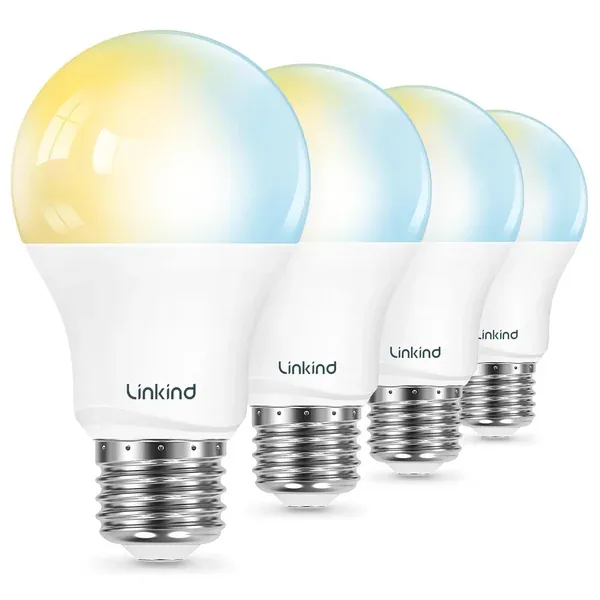
The Linkind A19 Smart Light Bulb (4-Pack, non-Matter) is a tunable white LED designed for standard E26 sockets. Based on the product listing and manufacturer information, each bulb draws 8.5W to produce 800 lumens — a 60W incandescent equivalent — and covers color temperatures from warm white (2700K) through cool daylight (6500K). The color rendering index exceeds 90, meaning it reproduces more than 90% of true object colors, which Linkind positions as suitable for makeup, food photography, and art display. Rated lifespan is 25,000 hours, or roughly 10 years at typical usage.
Connectivity is handled by a dual 2.4GHz WiFi and Bluetooth radio. The AiDot app manages setup and ongoing control; voice control runs through Amazon Alexa or Google Home without a separate hub. This is a non-Matter variant — Linkind does produce separate Matter-enabled bulbs (reviewed by PCWorld, PCMag, and The Ambient), but those are distinct SKUs with different feature sets.
Build Quality and Safety
According to the manufacturer, the bulb uses an A19 form factor with an E26 base. Published coverage of Linkind's broader bulb lineup (
matteralpha.com) describes the physical construction as a lightweight plastic dome over an aluminum base — a common configuration in this category that helps distribute heat. No specific CPSC recall or safety action is referenced in the available sources for this product line.
Dimming is software-controlled (1%–100% range) and is not compatible with traditional in-wall dimmer switches; the manufacturer explicitly warns that pairing with a traditional dimmer may cause flickering. Dimming must be done through the AiDot app, Alexa, or Google Home.
Real-World Fit: Who It Suits, Who Should Skip
This 4-pack is well-suited to renters or households new to smart lighting who want flexible color temperature in a single bulb without committing to a hub or a premium ecosystem. The offline Bluetooth fallback — which allows local control after initial setup even without an active internet connection — is a practical differentiator for spaces with inconsistent WiFi coverage, such as hallways or bedrooms.
The group control feature, which lets multiple bulbs be managed with a single app command, adds convenience for anyone outfitting an entire room at once. Timer and schedule functions (including a simulated sunrise/sunset) round out the automation options.
Who should skip it: Anyone on a 5GHz-only WiFi network will hit a hard wall — initial setup requires a 2.4GHz connection, and the bulb does not support 5GHz bands. Shoppers who already own or plan to buy Matter-compatible hubs (Apple Home, Samsung SmartThings, Hubitat) should look at Linkind's separate Matter SKUs instead; community forum discussion on Hubitat (
community.hubitat.com) flags connectivity and control-loss issues even with Matter-enabled Linkind bulbs under certain configurations, suggesting the broader ecosystem integration is still maturing. This non-Matter version has no Matter pathway at all.
How It Compares in the Category
Linkind positions this bulb against traditional 60W incandescents, citing up to 85% energy savings. Within the smart-bulb space, Linkind's own lineup spans from 800-lumen A19s (this product) through 1,100-lumen and 1,600-lumen A21 variants, per the manufacturer's product pages. The 800-lumen output is appropriate for 10–20 m² rooms per the listing, but buyers needing brighter coverage for larger spaces may want to evaluate the higher-lumen models.
PCWorld's and PCMag's coverage of the Matter-enabled Linkind variants praised light quality and smooth dimming at a competitive price point; those attributes originate from a related but distinct product and cannot be directly applied to this non-Matter SKU.
Honest Limitations
- 2.4GHz only: No 5GHz support creates a genuine compatibility gap for modern mesh routers configured for band steering.
- No Matter support: This listing is explicitly flagged as non-Matter, locking users into the AiDot/Alexa/Google Home ecosystem without broader interoperability options.
- Dimmer switch incompatibility: Traditional wall dimmers can cause flickering; software dimming is the only supported path, which may require workflow changes.
- Flickering troubleshooting: Published guidance (smartgeekhome.com) notes that Linkind bulb flickering — while often resolvable via a reset — is a documented enough occurrence to have dedicated fix guides, worth knowing before purchase.
- App dependency for full features: While basic Bluetooth local control works offline, full scheduling and scene features depend on the AiDot app and, for remote access, an active internet connection.
This review synthesizes the product listing, manufacturer feature descriptions, and published third-party coverage. No hands-on installation or use was conducted.
Darrell Steward
1 Feb, 2021Brilliant
This is the best product that has ever been made. It is also one of the best items in the world right now. Definitely go for it.
Albert Flores
17 Oct, 2020Just WOW
It's good to use this product for development as it has very good performance, display quality and all other features.