What It Is and Key Specs
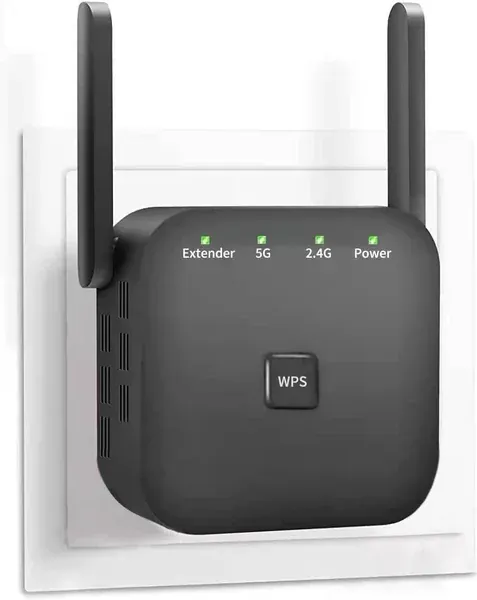
This WiFi extender — marketed under the "2026 Fastest" branding — is a plug-in repeater designed to stretch an existing router's signal into dead zones. According to the manufacturer's listing, it claims coverage up to 10,000 sq. Ft. And can connect up to 80 devices simultaneously, including smartphones, laptops, tablets, smart speakers, IP cameras, IoT devices, and Alexa-compatible products. It features two external high-gain antennas and includes an Ethernet port, which allows a wired connection to a nearby device — useful for smart TVs or gaming consoles in rooms where running a cable to the main router isn't practical.
Setup is described as two-pronged: a WPS (Wi-Fi Protected Setup) button allows for one-touch pairing with a compatible router, and a step-by-step configuration process is also available for those whose routers don't support WPS. The unit is plug-and-play in the truest sense — plug into an outlet, pair via WPS, and reposition as needed.
Build Quality and Design
The device features a wall-plug form factor with two repositionable external antennas. No independent lab testing or third-party teardown data is available in published sources to evaluate internal component quality. The listing does not specify the Wi-Fi generation (e.g., Wi-Fi 5, Wi-Fi 6, or Wi-Fi 6E), which is a notable omission given that industry coverage — including from PCMag (https://www.pcmag.com/picks/the-best-wireless-range-extenders) — consistently notes that matching your extender's Wi-Fi standard to your router's is important for maximizing performance. Buyers with newer Wi-Fi 6 or Wi-Fi 7 routers should verify compatibility before purchasing.
Real-World Fit: Who It Suits, Who Should Skip
This extender is a reasonable candidate for renters, apartment dwellers, or homeowners with a mid-size home who want a no-fuss way to push a signal into a lagging corner or back bedroom. The WPS one-touch setup and Ethernet port are practical additions that broaden its appeal beyond purely wireless use cases — Wirecutter notes (https://www.nytimes.com/wirecutter/reviews/best-wi-fi-extender/) that adding an Ethernet jack to another room wirelessly is a legitimate and underserved use case for plug-in extenders.
However, buyers with large, complex home layouts or those who have already invested in Wi-Fi 6 or Wi-Fi 7 routers may find this extender limiting. Coverage claims of 10,000 sq. Ft. Should be treated as ideal-condition figures; real-world range is typically affected by walls, floors, interference, and router output.
A Known Category-Level Limitation: The Separate Network Problem
A structural limitation worth understanding applies broadly to range extenders in this category. As noted by NetSpot (https://www.netspotapp.com/hardware/best-wifi-extenders/), WiFi range extenders create a separate network — meaning devices must switch from the main network to the extended network as users move through the home. Some devices handle this transition automatically; others require a manual switch. This is not a flaw unique to this product, but it is a common friction point across this tier of extender that mesh networking systems are designed to avoid.
Honest Limitations
- Wi-Fi standard not disclosed: The listing does not specify whether this is a Wi-Fi 5, Wi-Fi 6, or newer device. Published roundups from Tom's Guide (https://www.tomsguide.com/us/best-wifi-extenders,review-2225.html) and BroadbandNow (https://broadbandnow.com/guides/best-wifi-router-extenders) consistently highlight Wi-Fi generation as a key differentiator in extender performance — its absence here makes direct comparison difficult.
- Coverage claims are manufacturer-stated: The 10,000 sq. Ft. Figure is drawn from the product listing and is not independently verified by any cited source.
- Separate network behavior: As noted above, seamless roaming between the main and extended networks is not guaranteed.
- Mixed reader sentiment: A readers' aggregate of 3.9/5 from 631 Amazon ratings reflects generally positive but divided opinion — a meaningful share of buyers have reported reservations worth factoring into the decision.
Bottom Line
For buyers who need a simple, affordable way to extend a basic home network into a dead zone — and who value the added flexibility of an Ethernet port — this extender covers the fundamentals. Those with newer routers, performance demands, or large multi-story homes may be better served by a Wi-Fi 6-certified extender or a mesh system, both of which are explored in depth by Wirecutter and PCMag's roundups.
Darrell Steward
1 Feb, 2021Brilliant
This is the best product that has ever been made. It is also one of the best items in the world right now. Definitely go for it.
Albert Flores
17 Oct, 2020Just WOW
It's good to use this product for development as it has very good performance, display quality and all other features.