What It Is and Key Specs
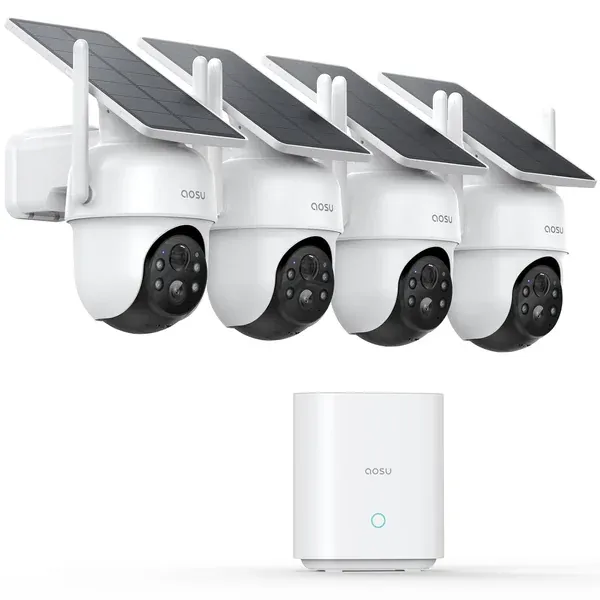
The aosu D1 Classic is a four-camera outdoor security kit centered on a hub-based local storage model. Each camera is solar-powered with a built-in panel, operates on pan-and-tilt mechanics for 360° coverage, and shoots at 3MP (2K) resolution. According to the manufacturer listing and aosu's own product pages, each unit features a 166° ultra-wide-angle lens, dual-band Wi-Fi (2.4GHz and 5GHz), and four integrated LED spotlights for color night vision.
The system's hub — called aosuBase — ships with 32GB of built-in storage. The manufacturer states this supports up to four months of loop recording without any subscription or recurring fee. All recordings are encrypted and stored locally; aosu notes that even if individual cameras are damaged or stolen, the footage remains on the hub.
Build Quality and Safety
The cameras are designed for outdoor installation. The manufacturer states three drilled holes and approximately five minutes are sufficient per camera — a claim that points to a relatively straightforward mount-and-connect setup, though individual results will depend on wall material and Wi-Fi signal strength at the chosen location.
On safety: no CPSC recalls are on record for security products of this type as of July 24, 2026, per
SaferProducts.gov.
The manufacturer states that three hours of daily sunlight is sufficient to keep the battery charged through typical conditions, including cloudy and rainy days. Published coverage from
camerarecaps.com corroborates the solar-plus-battery design. Buyers in regions with extended low-light winters should factor in that solar yield will vary seasonally — no security camera solar panel overrides the physics of reduced daylight hours.
Software and Ecosystem Features
The aosuBase hub does more than store video. Per the manufacturer listing and
surveillanceguides.com's review, it delivers:
- Cross-camera tracking: Automatically links video clips from multiple cameras covering the same event window, simplifying review of incidents that move across zones.
- Four-way live view: All four camera feeds can be monitored simultaneously on a single screen.
- One-click group controls: Working status of all cameras can be toggled together rather than managed individually.
- AI-powered smart alerts: Flagged in published coverage as a feature for filtering motion notifications.
These are software differentiators that lean into the hub-centric architecture — something worth noting for buyers who prefer a cloud-optional approach.
Real-World Fit: Who It Suits, Who Should Skip
This kit is well-matched to homeowners who want whole-property coverage without monthly fees, have reasonable sun exposure at intended mounting locations, and prefer keeping footage off third-party servers. The 166° wide-angle lens and 360° pan-and-tilt together reduce the number of cameras needed to cover most residential footprints.
Renters, apartment dwellers, or anyone needing indoor coverage will find limited applicability — this is an outdoor-focused, drill-to-mount system. Buyers in heavily shaded or north-facing installations should approach the solar claims with measured expectations; supplemental charging options are not described in available sources. Users with spotty Wi-Fi at property edges may also encounter the connectivity interruptions noted as a common issue in troubleshooting resources from
hellotroubleshooting.com and
onlytroubleshooting.com.
Honest Limitations
- Solar dependency: Performance in low-sunlight environments is not independently verified in available sources. The three-hour-per-day claim comes from the manufacturer.
- Connectivity sensitivity: Published troubleshooting coverage identifies firmware glitches and connectivity drops as recurring user-reported issues. Aosu support is reachable at support@aosulife.com.
- Single-hub storage ceiling: 32GB is a fixed ceiling. Loop recording means the oldest footage is overwritten; there is no described path to expand local storage beyond that built-in capacity.
- Ecosystem lock-in: The cross-camera tracking and group-control features are tied to the aosuBase hub. The cameras are not described as compatible with third-party NVRs or platforms.
Bottom Line
The aosu D1 Classic 4-Cam Kit presents a coherent value proposition: local storage, no subscription, solar power, and multi-camera intelligence in a single kit. The 4.4-star aggregate from more than 3,000 readers, as cited in published coverage, suggests broad satisfaction at its price tier. The trade-offs — solar variability, a fixed storage ceiling, and reported occasional connectivity hiccups — are real but not unusual for this category. Buyers who match the intended use case and sun exposure profile will find the feature-to-cost ratio competitive; those with significant shade constraints or cloud-platform preferences should look elsewhere.
Darrell Steward
1 Feb, 2021Brilliant
This is the best product that has ever been made. It is also one of the best items in the world right now. Definitely go for it.
Albert Flores
17 Oct, 2020Just WOW
It's good to use this product for development as it has very good performance, display quality and all other features.