What It Is and Key Specs
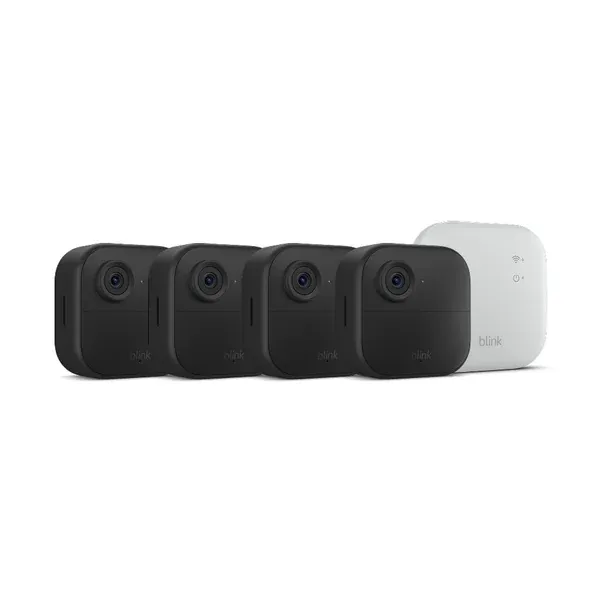
The Blink Outdoor 4 XR is a four-camera wireless security system built around Blink's new Sync Module XR hub. The central feature is extended range: according to the manufacturer, cameras can be placed up to 1,000 feet (open air) or 400 feet (typical use) from the Sync Module — a claim Blink describes as four times the distance of its cameras operating on Wi-Fi alone.
The system ships with the Sync Module XR and four Outdoor 4 cameras. Per the manufacturer, two-year battery life is achievable when the cameras are used with the Sync Module XR and Energizer Lithium AA batteries, both of which are included in the box. That claimed longevity is tied to Blink's patented chip technology and applies specifically to the XR configuration — the listing does not extend that promise to Wi-Fi-only operation.
Storage is flexible: an included 30-day free trial of the Blink Subscription Plan covers cloud storage, while local storage is available via a MicroSD card (up to 256 GB, sold separately) inserted into the Sync Module XR. The system supports up to 10 Blink devices through the Blink app and is compatible with Alexa for voice control of live view, arming, disarming, and motion-trigger routines.
Build Quality and the 900 MHz XR Difference
The meaningful hardware story here is the Sync Module XR itself. Blink describes it as the first system hub to extend Blink Outdoor 4 camera range, operating on the 900 MHz band rather than the standard 2.4 GHz or 5 GHz Wi-Fi bands. The manufacturer states this frequency choice avoids typical Wi-Fi congestion, resulting in live view loading 20% faster and up to 70% fewer disconnects compared to Wi-Fi operation.
These figures come directly from Blink's listing and should be understood as manufacturer claims rather than independently verified benchmarks. The 900 MHz band does have recognized physics-based advantages in penetrating obstacles and maintaining signal at distance — a well-documented characteristic of lower-frequency radio — but real-world results will vary by property layout, building materials, and local interference.
Real-World Fit: Who This Suits and Who Should Skip It
This system is most relevant to property owners with large footprints — acreage, long driveways, barns, outbuildings, or detached garages — where a standard Wi-Fi camera would lose signal or perform unreliably. The 400-foot typical-use range is a more realistic planning number than the 1,000-foot open-air maximum, and buyers should dimension their layout against that figure.
The all-in-one bundle (four cameras, Sync Module XR, batteries included) lowers the barrier to entry for first-time smart security buyers. Alexa integration and a single-app experience controlling up to 10 devices also suit households already invested in the Amazon ecosystem.
Buyers who need only one or two cameras close to their router, or who require continuous 24/7 recording without a subscription, may find this system over-specified or limiting. Cloud storage beyond the trial period requires an ongoing Blink Subscription Plan.
Setup and Connectivity: Known Friction Points
Published user support threads sourced from JustAnswer indicate that some Outdoor 4 XR owners encounter activation failures and module connectivity problems during initial setup. A steady blue light on the Sync Module XR is reported as a symptom of connection issues rather than successful pairing. Separately, battery recognition errors during setup have been flagged by users attempting to bring cameras online.
These are not universal experiences — the readers' aggregate on Amazon sits at 4.1/5 from 5,150 ratings, which reflects a broadly positive owner base — but the pattern is consistent enough across support forums to warrant caution. Buyers should budget time for troubleshooting during installation and ensure firmware is current before assuming hardware fault.
Honest Limitations
- The two-year battery claim is conditional: it requires the Sync Module XR and the included Energizer Lithium AA batteries; deviation from either may affect longevity.
- Local storage requires a MicroSD card purchased separately (up to 256 GB).
- The 1,000-foot range is an open-air maximum; the manufacturer's own "typical use" figure is 400 feet.
- Setup activation issues and connectivity errors during onboarding are documented in user support channels, though they are not universal.
- Performance and speed figures (20% faster live view, 70% fewer disconnects) are manufacturer-stated and not independently benchmarked in available sources.
Darrell Steward
1 Feb, 2021Brilliant
This is the best product that has ever been made. It is also one of the best items in the world right now. Definitely go for it.
Albert Flores
17 Oct, 2020Just WOW
It's good to use this product for development as it has very good performance, display quality and all other features.