What It Is and Key Specs
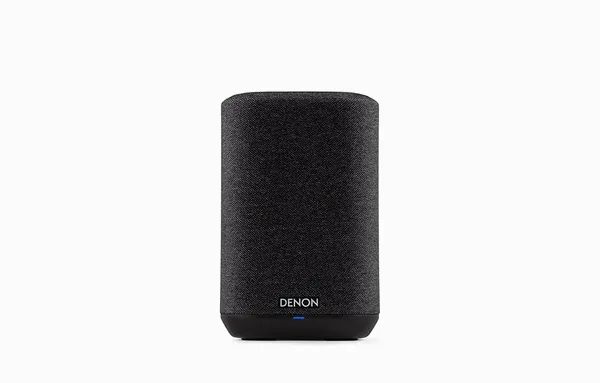
The Denon Home 150 is a compact wireless smart speaker designed to slot into Denon's broader HEOS ecosystem. According to the manufacturer listing, it measures a rounded rectangular form factor and weighs 3.8 pounds — figures corroborated by PCMag's review, which clocks dimensions at 7.4 by 4.7 by 4.7 inches (HWD) with a gray wraparound cloth grille (
PCMag).
Inside, Denon fits a 1-inch tweeter and a 3.5-inch woofer, driven by two Class D amplifiers. Connectivity is broad: Wi-Fi, Bluetooth, AirPlay 2, and a USB port on the rear. That USB port enables local playback of high-resolution files — including FLAC and ALAC up to 192kHz/24-bit, WAV, DSD 2.8MHz and 5.6MHz, plus standard formats like MP3, AAC, and WMA, per Denon's own product page (Denon US). Gapless playback is supported for hi-res network files as well (Denon Global). Streaming services covered include Spotify, TIDAL, and Pandora. Voice assistant support spans Alexa (built-in), Siri (via AirPlay 2), and Spotify Connect.
Build Quality and Sound Character
Consumer Reports, which independently assessed the speaker, rates its overall sound quality as
Very Good, noting that "bass has good impact and goes fairly deep, but is a bit prominent and boomy" (
Consumer Reports). That characterization aligns with Tom's Guide calling it "the best entry-level smart speaker for a home entertainment system" for bass-forward listeners, while acknowledging its versatility with hi-res and DSD support (
Tom's Guide). ECoustics describes the audio performance as having "pleasantly exceeded expectations, delivering clear mid-range" for its size and cost (
eCoustics).
The speaker carries a gray wraparound cloth grille and a rounded rectangular profile — a utilitarian but tidy design suited to shelves or side tables. Readers on Amazon give it a 4.1/5 aggregate from 608 ratings, suggesting broad satisfaction, though aggregate scores naturally mask individual outliers.
HEOS Ecosystem and Smart Features
HEOS is the central value proposition here. The platform allows the Home 150 to participate in multi-room audio setups alongside other Denon Home speakers, soundbars, and AV receivers — playing the same song throughout the home or different tracks per room, per the manufacturer. Setup follows a guided flow through the HEOS app and supports both wireless and wired (Ethernet) network connections, as detailed in the official Denon setup guide (
Denon Manuals).
The manufacturer also specifies a surround-sound expansion path: pairing two Home 150 units as rear surrounds with the Denon Home Soundbar 550 and a subwoofer to form a 5.1 cinematic system. For buyers already in the Denon ecosystem, this modularity is a meaningful differentiator.
Real-World Fit: Who It Suits, Who Should Skip
The Home 150 targets listeners who want a small-footprint smart speaker with genuine hi-res audio chops, multi-room flexibility, and a clear upgrade path within the Denon/HEOS family. Tom's Guide singles it out as particularly well-suited to home-entertainment integration rather than pure casual listening.
Those prioritizing the smartest voice-assistant experience may want to look elsewhere. PCMag notes that the Sonos One — at a lower price point — "offers a better smart speaker experience all around" (
PCMag), which is a meaningful callout for buyers whose primary use case is voice-first interaction rather than audio fidelity.
Honest Limitations
Several limitations are worth flagging based on published sources and documented user feedback:
- Bass tuning skews prominent. Consumer Reports flags the bass as "a bit prominent and boomy," which may not suit listeners who prefer a flatter, more neutral response.
- HEOS app and Alexa integration can require troubleshooting. Multiple user-support threads document Wi-Fi connection difficulties and the need to re-link the HEOS skill in the Alexa app, disable and re-enable integrations, or check firmware updates before setup resolves cleanly (JustAnswer; JustAnswer).
- Smart speaker experience is secondary to audio. PCMag's comparison to Sonos One suggests buyers who prioritize seamless smart-home integration over sound quality may find more purpose-built alternatives at a similar or lower price.
- Single-speaker stereo limits. Full stereo requires purchasing a second Home 150 unit, which adds to the total cost of ownership.
Darrell Steward
1 Feb, 2021Brilliant
This is the best product that has ever been made. It is also one of the best items in the world right now. Definitely go for it.
Albert Flores
17 Oct, 2020Just WOW
It's good to use this product for development as it has very good performance, display quality and all other features.