What It Is and Key Specs
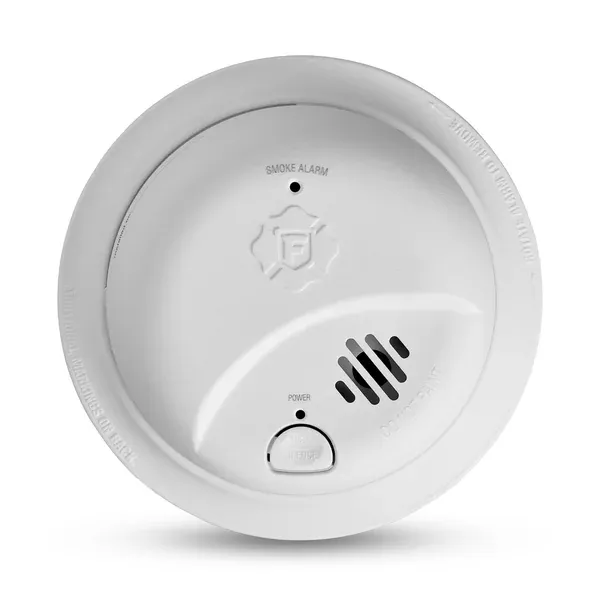
The First Alert SMI110 is a standalone, battery-powered smoke alarm built around what First Alert calls Precision Detection — an advanced sensing technology the company says complies with new industry standards aimed at reducing nuisance alarms triggered by everyday cooking while still delivering early warning in a genuine fire emergency. According to the manufacturer's listing, the alarm is powered by a sealed 10-year battery, meaning no battery door to open and no replacement cells to track down for the full service life of the unit. When that service life is over, an end-of-life warning signal alerts occupants that it's time to swap out the entire alarm rather than just a battery. A Test/Silence button rounds out the feature set, allowing occupants to confirm the alarm is functioning and to hush nuisance alerts without removing the unit from the ceiling.
First Alert positions the SMI110 within a broader lineup that also includes hardwired, interconnected, and combination smoke/CO models, as noted across the manufacturer's own product pages (
firstalert.com, firstalertstore.com). The SMI110 is a standalone, single-threat (smoke only) device — it does not detect carbon monoxide.
Build Quality and Safety Considerations
First Alert is one of the most widely distributed smoke alarm brands in North America, and independent coverage from sources such as
Popular Mechanics notes that First Alert alarms carry UL Solutions certification, an industry benchmark for fire-safety devices (
popularmechanics.com). The sealed battery construction eliminates the low-battery chirp that plagues conventional alarms and, per manufacturer documentation, is designed to remain operational for the full decade without intervention.
An important safety note: The U.S. Consumer Product Safety Commission (CPSC) has previously recalled other First Alert smoke alarms — including a notable recall for rapidly draining battery power (
cpsc.gov) — though no record checked as of 2026-07-24 names this specific SMI110 model. That absence is not a verified all-clear. Buyers should check the CPSC recall database directly before and after purchase, and register the product with First Alert to receive any future safety notices.
Real-World Fit: Who It Suits, Who Should Skip
The SMI110 is well-suited to renters, secondary bedrooms, or any space where running new wiring isn't practical. The sealed battery design makes it particularly appealing for anyone who has experienced the 3 a.m. Low-battery chirp that plagues conventional alarms — that scenario is eliminated by design. The Precision Detection feature addresses one of the most common complaints about kitchen-adjacent alarms: chronic false trips from toast or steamy showers.
Households that want
carbon monoxide protection in the same unit should look elsewhere in First Alert's lineup — the brand offers combination smoke/CO models that handle both threats (
firstalert.com). Similarly, buyers who want
interconnected alarms — where triggering one sounds all units in the home — will need to evaluate whether the SMI110 supports that feature, as interconnect capability varies by model within the First Alert range (firstalertstore.com).
Honest Limitations
A few friction points are worth naming plainly:
- Smoke only. No CO detection. In a market where combination alarms are increasingly common and often similarly priced, single-threat coverage is a real trade-off.
- Non-replaceable battery means full-unit replacement at 10 years. While this eliminates maintenance during the service life, it does mean the entire alarm goes to landfill at end of life rather than just a cell.
- End-of-life chirping behavior can still be a source of confusion. First Alert's own troubleshooting resources (firstalertstore.com) and third-party guides (troubleshootinglab.com) document that chirps, beeps, and indicator light patterns can be misread — worth reviewing before installation so household members understand what each signal means.
- Broader brand recall history. As noted above, First Alert has had CPSC recalls on other models in this category. This doesn't indict the SMI110 specifically, but it's a factor informed buyers should weigh.
Darrell Steward
1 Feb, 2021Brilliant
This is the best product that has ever been made. It is also one of the best items in the world right now. Definitely go for it.
Albert Flores
17 Oct, 2020Just WOW
It's good to use this product for development as it has very good performance, display quality and all other features.