What It Is and Key Specs
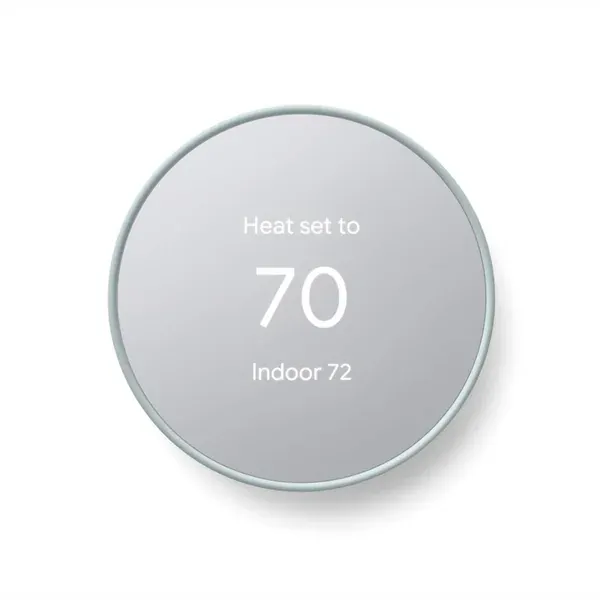
The Google Nest Thermostat in Fog is a programmable, Wi-Fi-connected smart thermostat carrying ENERGY STAR certification. According to Google's official tech specs (
store.google.com), it works with most 24V heating and cooling systems — including furnaces, air conditioners, boilers, and heat pumps with forced air or radiant delivery — and supports conventional systems with one stage of heating or cooling.
Core features, as described in the manufacturer listing, include:
- Auto-away detection: The thermostat turns itself down when you leave, avoiding energy waste in an empty home.
- Savings Finder: An in-app feature that analyzes your schedule and suggests further efficiency tweaks.
- HVAC monitoring: The thermostat watches for irregularities in your heating and cooling system and sends maintenance alerts.
- Remote control: Family members can adjust temperature from any phone, laptop, or tablet.
- Voice control: Compatible with Google Assistant and all Matter-certified voice assistants, as well as Alexa, provided a compatible smart device is present.
- Nest Renew integration: An optional feature that helps users prioritize energy use during cleaner or less expensive grid periods.
Google's comparison page (
store.google.com/magazine/compare_thermostats) positions this model as the entry point in the Nest lineup, sitting below the learning-capable Nest Learning Thermostat. Reviewers at TechGearLab (
techgearlab.com) note its minimalistic round design and describe it as one of the easier smart thermostat models to set up, with strong installation guidance.
Build Quality and Safety
Published third-party coverage notes a clean, approachable aesthetic. Popular Mechanics (
popularmechanics.com) describes a glossy glass finish that integrates unobtrusively into living spaces, while Wired (
wired.com) observes that the round form factor reads as larger on a wall than its dimensions suggest — a subjective plus for those who prefer a prominent display.
On the safety front:
no CPSC recalls are on record for Google products of this type as of 2026-07-24 (
saferproducts.gov).
Real-World Fit: Who It Suits, Who Should Skip
This thermostat is well-matched for homeowners or renters with standard 24V HVAC systems who want app-based scheduling, remote access, and basic energy tracking without the premium price of the Nest Learning Thermostat. The Google Home app (Android and iOS) is the primary interface for schedule creation and savings suggestions.
However, several compatibility caveats are worth noting upfront. Per the manufacturer's own listing,
the Nest Thermostat is designed to work without a C wire in most homes, but heating-only, cooling-only, zone-controlled, and heat pump systems may require a C wire or compatible power accessory. Buyers should use Google's Nest Compatibility Checker — available on the Google Nest support page — before purchasing. Google's own support documentation (
support.google.com) confirms that wire and power issues are among the more common causes of heating and cooling irregularities after installation.
Those who want a thermostat that
automatically learns temperature preferences over time — rather than requiring manual schedule input — should look at the Nest Learning Thermostat (4th gen), which Consumer Reports (
consumerreports.org) covers as a distinct, higher-priced product with that self-learning capability built in.
Honest Limitations
No product is without trade-offs, and the Nest Thermostat has a few worth flagging:
- No self-learning: Unlike the Nest Learning Thermostat, this model requires users to build their own schedule in the Google Home app rather than having the device infer preferences automatically.
- C-wire dependency for some systems: As Google explicitly states, certain HVAC configurations will not work without additional wiring or accessories.
- Internet dependency for full functionality: While the thermostat can be controlled manually without an internet connection, remote access, voice control, and smart features all require connectivity.
- Troubleshooting complexity: Independent coverage (ars.com) identifies scenarios — such as a clogged air filter causing charging failures — where diagnosing issues requires some user effort and HVAC familiarity.
- Voice control requires a separate device: Google Assistant or Alexa functionality is not self-contained; a compatible smart speaker or display is needed.
How It Compares in the Nest Lineup
Google's own comparison tool (
store.google.com/magazine/compare_thermostats) makes clear that this thermostat occupies the entry tier of the Nest family. TechGearLab notes it outperforms some premium competitors in certain respects despite its more accessible price point, particularly around ease of installation and app guidance. For buyers whose primary goals are remote control, scheduled programming, and energy alerts — rather than hands-off learning — the standard Nest Thermostat covers those bases without the step-up cost.
Darrell Steward
1 Feb, 2021Brilliant
This is the best product that has ever been made. It is also one of the best items in the world right now. Definitely go for it.
Albert Flores
17 Oct, 2020Just WOW
It's good to use this product for development as it has very good performance, display quality and all other features.