What It Is and Key Specs
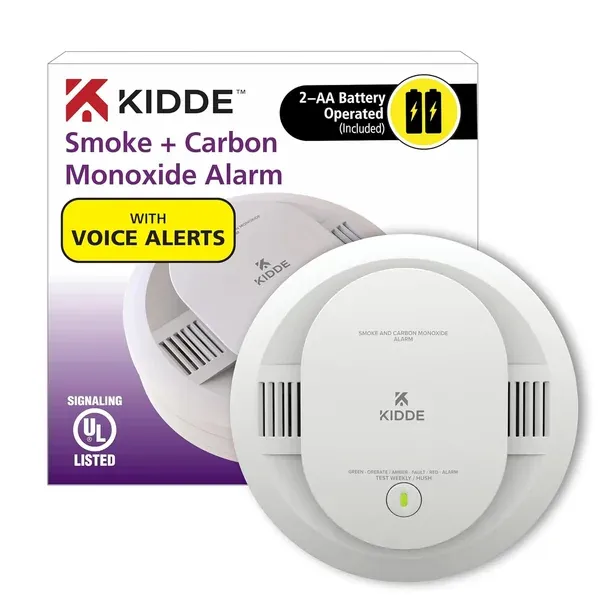
Based on the manufacturer listing and Kidde's published product information, this is a standalone, battery-operated combination alarm that detects both smoke and carbon monoxide in a single unit. Power comes from two included AA batteries — no hardwiring required — making it operable even during power outages. The alarm produces an 85-decibel siren and uses a three-color LED system: green for normal operation, amber for an operating error, and red for a smoke, fire, or CO event.
Detection relies on two separate sensor technologies. A photoelectric sensor targets visible fire particles associated with slow, smoldering fires, while an electrochemical sensor handles carbon monoxide detection. Kidde notes the device performs within an operating range of 40–100 degrees Fahrenheit and that high humidity, steam, or condensation may cause false alarms — practical placement considerations documented on
Kidde's support page.
The alarm ships with a mounting bracket and supports installation in four orientations. Kidde backs the alarm hardware with a 10-year limited manufacturer warranty, which begins at first power-on; if that date is unknown, Kidde states replacement should be assumed.
Build Quality and Voice Alert System
A standout feature from the listing is the voice alert function. Rather than an undifferentiated siren, the alarm announces the specific hazard: "Fire!" for smoke or fire events, "Warning Carbon Monoxide" for CO gas, and "Low Battery" when batteries need replacing. This distinction can matter in real emergencies, allowing occupants to respond differently to a smoldering fire versus a CO leak.
The device also runs 24/7 self-testing of internal components, though Kidde explicitly notes this is not a substitute for a manual push test — a useful reminder for periodic maintenance.
Safety Considerations and CPSC Record
This section warrants careful attention. Kidde has a documented history of CPSC recalls on combination smoke and CO alarms. Most notably, a
2021 recall of Kidde TruSense Smoke and Combination Smoke/Carbon Monoxide Alarms found that affected units could fail to alert consumers to a fire. An earlier
2009 recall of Dual Sensor Smoke Alarms carried a similar risk.
As of this review's sourcing date (2026-07-24), no CPSC record specifically names this exact model. However, that absence is
not a verified all-clear — it confirms only that this model was not found in the recall database at time of checking, not that it has been formally cleared. Buyers should verify current recall status directly at
cpsc.gov and on
Kidde's support page before and after purchase.
Real-World Fit: Who It Suits, Who Should Skip
This alarm is well-suited to renters, apartment dwellers, or homeowners who need code-compliant smoke and CO coverage without hiring an electrician. The battery-only design means zero wiring complexity and continued protection during power outages — a meaningful advantage in outage-prone areas.
Those seeking smart-home integration will need to look elsewhere. Independent reviews of other Kidde combo alarms in the same product family, such as coverage on
TechHive, note that even Kidde's higher-end models lack smart-home connectivity — a category-wide limitation for Kidde's non-Wi-Fi lineup. Similarly, buyers who want alarm interconnectivity — where one unit triggers all alarms in the home — should note that interconnectability is a feature of Kidde's hardwired models (such as the
900-CUAR); the listing for this battery-only unit does not list interconnect capability.
Honest Limitations
- No smart-home or app connectivity — the alarm cannot send remote notifications or integrate with platforms like Alexa, Google Home, or a security system hub.
- No alarm interconnectivity — triggering this unit does not simultaneously sound other alarms in the home, a feature common in hardwired alternatives.
- Humidity and temperature sensitivity — Kidde's own support documentation flags that steam, condensation, and temperatures outside 40–100°F can cause false alarms; bathroom or garage placement may be problematic.
- CPSC recall history on related models — while no active recall has been confirmed for this specific unit, Kidde's broader product line has seen multiple fire-safety recalls. Prospective buyers should monitor CPSC listings independently.
- Warranty start ambiguity — the 10-year warranty clock begins at first power-on, and Kidde states that if the power-on date is unknown, consumers should assume replacement is needed. Purchasing older shelf stock could meaningfully reduce the effective warranty period.
Darrell Steward
1 Feb, 2021Brilliant
This is the best product that has ever been made. It is also one of the best items in the world right now. Definitely go for it.
Albert Flores
17 Oct, 2020Just WOW
It's good to use this product for development as it has very good performance, display quality and all other features.