What It Is and Key Specs
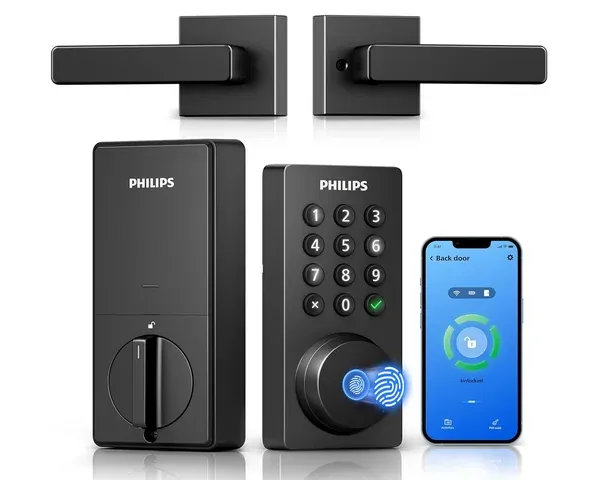
The Philips 4200 Series WiFi Keypad Door Lock is described in the product listing as a complete keyless-entry solution that combines a sturdy deadbolt mechanism, an integrated handle, and a built-in WiFi gateway — a characterization echoed by coverage at
theinsidereview.com. According to the manufacturer, it is designed for doors 1-3/8″ to 2″ thick, which covers most standard residential front doors.
Key specifications drawn from the listing:
- Connectivity: 2.4 GHz WiFi, direct to router — no hub or bridge required
- Unlock methods: Fingerprint (0.3-second claimed recognition), PIN keypad (permanent, one-time, periodic, and recurring codes), app remote unlock, and voice commands via Amazon Alexa or Google Assistant
- Auto-lock range: 0–180 seconds, configurable in the Philips Home Access App (off by default)
- Battery life: Up to 6 months of daily use on standard 1.5V alkaline batteries (not included); low-battery alerts built in
- Finish: Matte black
- Included hardware: Matching handle set — no separate hardware purchase needed
The lock sits within Philips' 4000/4200 Series tier, which is distinct from the entry-level 3000 Series Retrofit and more advanced models listed on the Philips USA smart security page.
Build Quality and Safety
The listing presents this as an all-in-one front-door upgrade with a deadbolt at its core, and third-party coverage at
limteam.net describes it as offering "a cohesive look for your door." The matte-black finish and bundled handle are designed to avoid the mismatched hardware that can result from mixing components from different manufacturers.
On the safety side, Philips' own troubleshooting documentation (
philips.sa) notes that door alignment matters: a sagging door can misalign the lock bolt and strike plate, potentially causing the motor to produce grinding noises without completing a lock cycle. This is a mechanical reality of any motorized deadbolt, not unique to this model, but it is worth confirming that the door frame is square before installation. Philips also publishes a dedicated troubleshooting guide for smart door lock issues, suggesting ongoing software and support investment in the product line.
Battery note from the manufacturer: Use only standard 1.5V alkaline batteries. Rechargeable or high-power lithium batteries are explicitly not recommended, as Philips states they may cause instability or damage.
Real-World Fit
This lock is well suited to:
- Households managing multiple users — the app supports permanent, one-time, periodic, and recurring PIN codes, making it practical for family members, housekeepers, or short-term rental guests
- Renters or owners who want remote visibility — real-time access history and door-status checks via the Philips Home Access App address the common "did I lock the door?" Concern
- Those avoiding smart-home hub costs — direct 2.4 GHz WiFi eliminates the need for a separate Zigbee or Z-Wave bridge
- Voice-assistant households — Alexa and Google Assistant compatibility is confirmed in the listing
Who should look elsewhere:
- Anyone whose WiFi router is more than 33 feet (10 m) from the front door, or where thick walls or metal obstacles are present — Philips explicitly flags this range limitation in the listing
- Buyers on doors outside the 1-3/8″ to 2″ thickness range
- Those who prefer or require a physical key backup — the listing does not mention a key cylinder, and coverage at limteam.net notes that a competing alternative includes a physical key backup that this model lacks
How It Compares in the Philips Lineup
Philips positions several smart lock tiers on its U.S. Site. The 3000 Series is a retrofit lock that works with a separate wireless keypad, while the 4200 Series integrates WiFi, fingerprint, keypad, and handle into one unit. Buyers who already have a handle they prefer may find the retrofit approach more economical; those doing a full front-door refresh will appreciate not having to source components separately.
Honest Limitations
- WiFi range is constrained. The 33-foot (10 m) router proximity requirement is a meaningful installation constraint in larger homes or where the front door is far from the nearest access point.
- Batteries not included, and chemistry matters. The 6-month estimate assumes standard alkaline cells; deviating from that can affect performance per the manufacturer's own guidance.
- Auto-lock is off by default. Users must enable this feature manually in the app — easy to overlook during initial setup.
- Door alignment is a prerequisite. As Philips' own support documentation acknowledges, a misaligned or sagging door can interfere with the motorized bolt, requiring carpentry fixes before the lock operates correctly.
- App dependency for advanced features. Code management, access history, and auto-lock configuration all route through the Philips Home Access App; users uncomfortable with cloud-connected locks or app ecosystems should weigh this.
Reader Verdict
Readers on Amazon give the Philips 4200 Series a 4.5 out of 5 aggregate rating across 647 ratings — a solid result for a smart lock at this feature level. The combination of hub-free WiFi, sub-half-second fingerprint access, flexible PIN types, and a bundled handle set makes it a genuinely comprehensive front-door package. The WiFi range caveat and door-alignment sensitivity are real considerations, but they are manageable with proper planning rather than fundamental design flaws.
This review synthesizes the Amazon product listing, manufacturer feature documentation, Philips' published support materials, and third-party editorial coverage. No hands-on installation was conducted.
Darrell Steward
1 Feb, 2021Brilliant
This is the best product that has ever been made. It is also one of the best items in the world right now. Definitely go for it.
Albert Flores
17 Oct, 2020Just WOW
It's good to use this product for development as it has very good performance, display quality and all other features.