What It Is and Key Specs
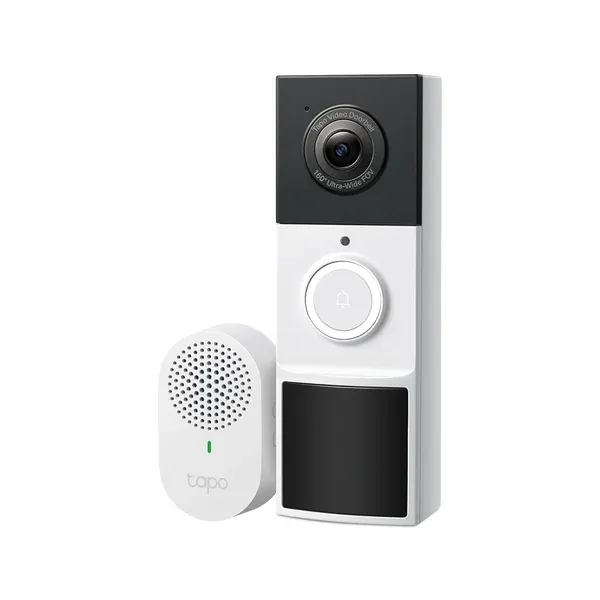
The Tapo D210 is a wire-free, battery-powered video doorbell aimed at homeowners who want smart security without locking into a recurring cloud plan. Key specifications, drawn from TP-Link's official product listing and store page, include:
- Resolution: 2K (3MP) — a step above conventional 1080p, intended to make faces and package labels more legible, even when digitally zoomed
- Field of view: 160° diagonal, described as a head-to-toe perspective that captures what narrower-angle competitors may miss at the entryway
- Battery: Rechargeable 6,400mAh, designed to extend time between charges and allow flexible placement without proximity to wiring
- Night vision: Full-color, powered by an onboard spotlight that activates on motion detection (brightness adjustable)
- Connectivity: 2.4GHz Wi-Fi only
- Storage: Local microSD (up to 512GB, not included; Class 10, UHS-1 endurance cards recommended) or optional Tapo Care cloud subscription covering 30 days of history
- Included: Chime unit in the box
- Audio: Two-way audio with preset quick-response prompts
- Smart home: Compatible with Amazon Alexa and Google Home ecosystems, per published third-party coverage
The D210 arrives as part of a growing Tapo doorbell lineup. TP-Link's own store also lists the D225, which steps up to 2K QHD and a 180° field of view for shoppers who want even wider coverage.
Build Quality and Safety
No CPSC recalls are on record for Tapo products of this type as of July 24, 2026 (
saferproducts.gov). The D210's storage and transmission security is addressed by TP-Link through AES 128-bit encryption and TLS 1.2 protocols — a meaningful detail for buyers wary of cloud-connected cameras handling sensitive footage.
The physical build is not independently rated in the sources available for this review, so claims about weather resistance or long-term durability cannot be made here.
Real-World Fit
The D210 suits a specific type of buyer well. Gadget Guy's published coverage calls the battery life "class-leading" for a wireless device — a practical advantage for anyone who finds frequent recharging a dealbreaker. The included chime eliminates an extra purchase, and setup is described as straightforward in that same coverage.
Free person detection with customizable activity zones adds genuine value: rather than receiving a notification every time a leaf blows past, owners can configure alerts to trigger only on human presence. The Ring Call feature — which routes visitor alerts as a phone call rather than requiring the Tapo app to be open — is a convenience layer worth noting, though it operates over the internet and does not consume cellular minutes.
The D210 is a good fit for:
- Renters or homeowners who cannot or prefer not to run doorbell wiring
- Buyers who want local storage control without a subscription commitment
- Households already in the Alexa or Google Home ecosystem
Buyers who should look elsewhere:
- Those on 5GHz-only Wi-Fi networks (the D210 is 2.4GHz only)
- Users who want the widest possible field of view — TP-Link's own D225 offers 180° vs. The D210's 160°
- Anyone expecting a microSD card in the box
Honest Limitations
No product is without trade-offs, and the D210 is no exception.
Storage card not included. Local recording requires a separately purchased microSD card (up to 512GB). TP-Link specifically recommends high-endurance Class 10, UHS-1 cards, which adds to the out-of-pocket cost.
2.4GHz Wi-Fi only. Homes with congested 2.4GHz bands or routers configured primarily for 5GHz may experience connectivity friction.
Audio can require calibration. TP-Link's own support documentation (
tapo.com/us/faq/815) acknowledges audio quality issues and walks users through adjusting microphone and speaker volumes within the app — suggesting this is a common enough concern to warrant a dedicated FAQ. Buyers should plan for a setup step beyond the initial install.
Spotlight is the sole night-color mechanism. Full-color night vision depends on the onboard spotlight activating. In environments where a visible light source is unwanted or restricted (e.g., certain HOA rules), nighttime image quality may default to a more limited mode.
Reader sentiment, based on the aggregate ratings visible on the product page, can be referenced directly there for the most current snapshot of owner experience.
How It Compares
Within TP-Link's own lineup, the D210 sits below the D225, which trades the D210's 6,400mAh battery flexibility for a wider 180° FOV and QHD clarity. Buyers prioritizing the absolute widest view may want to compare both before deciding. Beyond TP-Link, the subscription-free local storage model is a meaningful differentiator in a category where many competitors default to cloud-only plans with ongoing fees.
Darrell Steward
1 Feb, 2021Brilliant
This is the best product that has ever been made. It is also one of the best items in the world right now. Definitely go for it.
Albert Flores
17 Oct, 2020Just WOW
It's good to use this product for development as it has very good performance, display quality and all other features.