What It Is and Key Specs
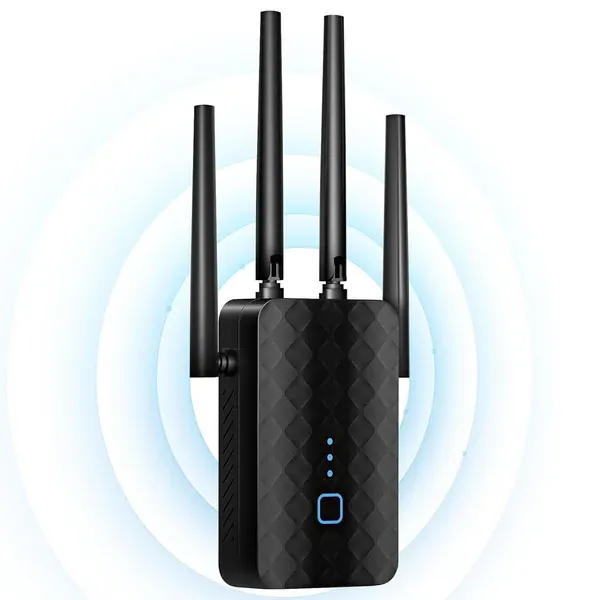
The LuvemHome WiFi Extender is a dual-band range extender operating on both the 2.4GHz and 5.8GHz (5GHz) bands, with a combined wireless throughput of up to 1,200 Mbps in Repeater Mode. It includes a 100 Mbps Ethernet port for wired AP Mode connections and supports up to 36 simultaneously connected devices. The manufacturer claims coverage of up to 10,000 sq. Ft., positioning this as a solution for larger homes, open floor plans, and spaces with physical obstacles like thick walls, cement floors, or large appliances.
Setup is handled via WPS button pairing — no app download or technical configuration required, according to the listing. Security features listed include WEP, WPA, and WPA2 protocol support, a described "Bionic Encryption Chip," and over-voltage protection.
Build Quality and Safety
The listing highlights an embedded security encryption module and over-voltage safeguarding, suggesting basic electrical protection is built into the hardware. As of July 24, 2026, the U.S. Consumer Product Safety Commission lists no recalls on record for WiFi products of this type, according to
saferproducts.gov. No independent lab certification data (such as FCC or UL listings) is referenced in available sources for this specific unit, so buyers who prioritize third-party safety validation may wish to verify that directly before purchasing.
Real-World Fit: Who This Suits and Who Should Skip It
For renters or homeowners dealing with localized dead zones in mid-size to large spaces, a dual-band extender with WPS setup and an included Ethernet port checks the practical boxes. The Ethernet port is a meaningful inclusion: as Wirecutter notes in its extender coverage, plugging bandwidth-heavy devices like media streamers or game consoles into an extender's Ethernet port — rather than connecting them via Wi-Fi — is generally the better approach, and this unit's 100 Mbps wired port supports that use case (
nytimes.com/wirecutter).
The straightforward WPS pairing suits non-technical users. However, shoppers in larger or more complex homes should be aware that, as industry coverage from Sparkmoor notes, over 60% of user complaints around WiFi booster setup issues stem from placement errors or incompatible devices — not the hardware itself. Placement relative to the existing router is critical for any extender to perform as advertised.
Users who need Wi-Fi 6 speeds or whole-home mesh performance should look elsewhere. PCMag's roundup of top extenders highlights Wi-Fi 6 models like the TP-Link RE715X as the current performance benchmark for buyers who prioritize throughput and modern protocol support (
pcmag.com). The LuvemHome unit's specs do not reference Wi-Fi 6, placing it in the more accessible but less future-proof tier of the category.
How It Compares in the Category
The dual-band, plug-in extender segment is crowded. TP-Link, ALFA, and other established brands offer competing products across a similar price tier, with some carrying more detailed independent lab or consumer testing data behind them. Consumer Reports, which measures extender throughput at both near range (8 feet) and far range (55 feet) across multiple test conditions, provides a useful benchmark framework — though the LuvemHome unit does not appear in that testing pool based on available sources (
consumerreports.org). Shoppers comparing options should weigh the absence of published third-party performance data against the unit's accessible feature set.
Honest Limitations
No product in this category is without trade-offs, and the LuvemHome extender is no exception:
- Wired port speed is capped at 100 Mbps. For households with gigabit internet service, the Ethernet port will bottleneck wired connections to devices like gaming consoles or smart TVs.
- Coverage claims are manufacturer-stated. The 10,000 sq. Ft. Figure is not verified by independent testing in available sources. Real-world results will vary significantly based on home layout, wall materials, and interference, as noted broadly across industry coverage (sparkmoor.com, gadgetreview.com).
- No Wi-Fi 6 support indicated. For users with newer routers and devices capable of Wi-Fi 6, this unit will not unlock those faster speeds.
- Firmware and compatibility. As GadgetReview's troubleshooting guidance notes, keeping both the extender and router firmware current is important for stability — an ongoing maintenance consideration for any extender (gadgetreview.com).
- "Bionic Encryption Chip" is proprietary marketing language with no third-party verification cited in available sources.
Reader Ratings
Readers have left an aggregate rating for this product, which is visible on the product page and reflects real-world buyer experience across a range of home environments and use cases.
Darrell Steward
1 Feb, 2021Brilliant
This is the best product that has ever been made. It is also one of the best items in the world right now. Definitely go for it.
Albert Flores
17 Oct, 2020Just WOW
It's good to use this product for development as it has very good performance, display quality and all other features.